
Power Bank Product Design & Platform Guide
A buyer guide to power bank product design and platform decisions, covering capacity, power, cable architecture, magnetic charging, form factor, product roles and the choice between mature platforms and deeper development.
Start with the product role before choosing the specification stack.
Capacity, wattage, cable architecture, magnetic charging and form factor should support a clear user and shelf role instead of competing only on feature count.
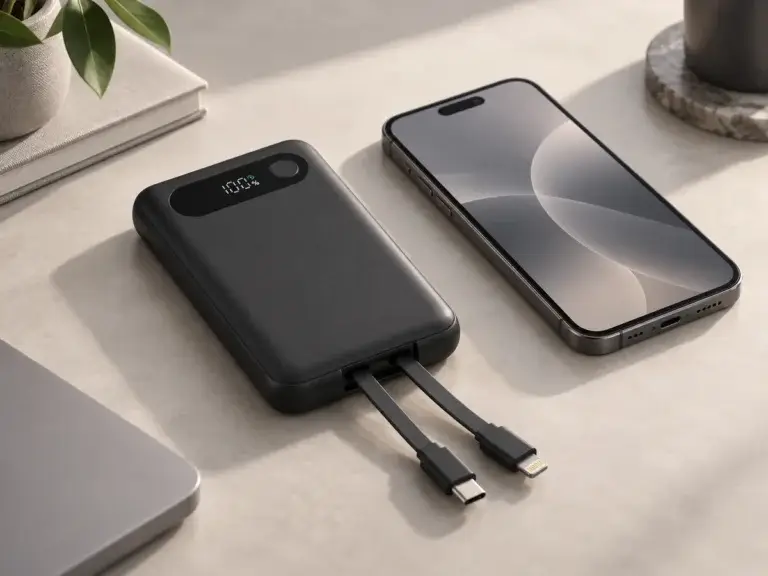

Choose the Platform by Use Case
Daily Carryslim · miniAll-in-One
built-in cableMagnetic
phone alignmentTravel
direct-plug · ACRetractable
cable managementHigh-Power
tablet · laptop
Four Product Decisions
SKU Roleentry · core · premiumForm Factor
mini · cable · magnetic · plugCapacity & Power
5K · 10K · 20K · 20W–45WCMF & Brand
color · finish · packaging
Product Design Workflow
User & channel → platform → capacity/power → CMF → engineering handoff.
01 · Defineuser · SKU02 · Select
platform · power03 · Differentiate
CMF · packaging04 · Handoff
engineering · DFM


Make Four Product Decisions Before Picking a Model
1 · User & ChannelDaily carry, travel, magnetic convenience, direct-plug use or higher-power charging. 2 · SKU Role
Entry, core, premium or a specialty SKU. 3 · Capacity & Power
Choose 5K, 10K or 20K and the required power by use case—not headline specs alone. 4 · Differentiation Depth
Use CMF and packaging when the platform already fits; move deeper only when the structure or UX must change.
Turn the Decision Into a Buildable Brief
Define target market, capacity, output, interfaces, CMF, packaging, quantity and timing before engineering review.
Product Specification Template → · Engineering Resources →
Choose the Lightest Route That Fits
Existing PlatformFrom 1,000 pcs/model Internal Modification
From 2,000 pcs/model Upgrade / Second Source
Define required match points and approved improvements New Private Mold
From 3,000 pcs/design
Typical mature-project baseline: 500 pcs/color · samples 7–10 days · mass production about 30 days.
Compare Development Routes → · Custom Development → · Send Product Brief →
Power Bank Product Design FAQ
How should a buyer choose 5,000mAh, 10,000mAh or 20,000mAh?
Choose by user and runtime need: 5K for compact carry, 10K for everyday use and 20K for longer runtime or higher-power devices. Size and weight rise with capacity. Capacity reference →
Built-in cable, retractable cable or direct-plug?
Built-in cable favors simple all-in-one use, retractable cable improves storage with more mechanism, and direct-plug prioritizes compact top-up without a loose cable. Match the form factor to how the customer carries and charges.
Does magnetic attachment automatically mean Qi2?
No. Magnetic attachment, wireless power and Qi2 certification are separate decisions. Define the required charging standard and certification scope for the exact SKU. WPC reference →
When is a mature ODM platform enough?
Use a mature platform when CMF, branding, packaging or limited changes create enough differentiation. Use a controlled upgrade or private mold when structure, mechanisms, electronics or interface positions must materially change. Private Mold & ODM →
Additional Product Design FAQ
How does charging power affect power-bank size and thermal design?
Higher charging power can require higher-current cells, larger power components, stronger connectors, more PCB copper and better heat paths. Output targets should be chosen together with size, battery and thermal constraints.
When should a built-in cable be chosen instead of a separate cable?
Choose a built-in cable when convenience and all-in-one use are important. Validate cable durability, connector fit, routing and output because the cable becomes part of the product architecture.
What should be considered when adding a stand to a magnetic power bank?
Review balance, hinge or support geometry, magnet alignment, charging-coil position, phone size range, case thickness and whether the stand affects enclosure thickness or battery space.
Why is mechanical stack-up important in a thin power bank?
Battery thickness, PCB height, connectors, wireless coils, displays, cables and housing ribs all compete for the same internal volume. Stack-up review prevents interference and unrealistic thickness targets.
How should a retailer choose between compact and high-capacity platforms?
Start with user behavior and channel. Compact products favor portability and impulse purchase, while higher-capacity products favor longer runtime and higher-power use. Size, weight and price should be considered together.
What should be defined before changing an existing platform's industrial design?
Define which dimensions, interfaces, internal components and user functions must stay fixed. Then identify the appearance and structural areas that can change without creating unnecessary engineering risk.
Explore the Other Guide Topics
Private Mold & ODM · Buyer & Sourcing · Engineering · Quality & Compliance
Need to Build a Clearer Power Bank Range?
Send the target user, channel, capacity range, power tier and preferred interaction format. ZEROSET can map the brief to existing platforms and identify where deeper development is justified.