
Power Bank mAh, Wh & Rated Capacity Reference
A buyer reference for interpreting power bank nominal capacity, watt-hours and rated output capacity, including mAh-to-Wh calculation, conversion losses, test conditions and packaging claims.
mAh alone does not describe the energy a power bank can deliver at its USB output.
Use nominal voltage and Wh to understand stored energy, then review rated output and stated test conditions separately because conversion, cable and thermal losses reduce usable output.

Power Bank mAh to Wh Calculator
Enter nominal cell capacity and nominal voltage. The calculator returns nominal stored energy in watt-hours.
38.50 WhFormula: Wh = mAh × V ÷ 1000. This is nominal stored energy, not guaranteed USB output energy. Nominal Capacity (mAh)
Charge quantity at the stated nominal cell voltage. Example: 10,000mAh at 3.85V.Nominal Energy (Wh)
Stored energy on a common basis. Example: 10,000mAh × 3.85V ÷ 1000 = 38.5Wh.Rated Output Capacity
Output-side capacity under a stated USB voltage and test condition; it is lower because conversion losses occur.
Quick Buyer Check
Use the same basis before comparing supplier capacity claims.
Nominal mAhConfirm capacity and nominal voltage, then convert to Wh. Wh
Check Wh against mAh × nominal voltage for the exact SKU. Rated Output
Compare only with the same output voltage and test condition. Test Basis
Load, cable, temperature and sample revision affect measured output.

Examples & Related Engineering
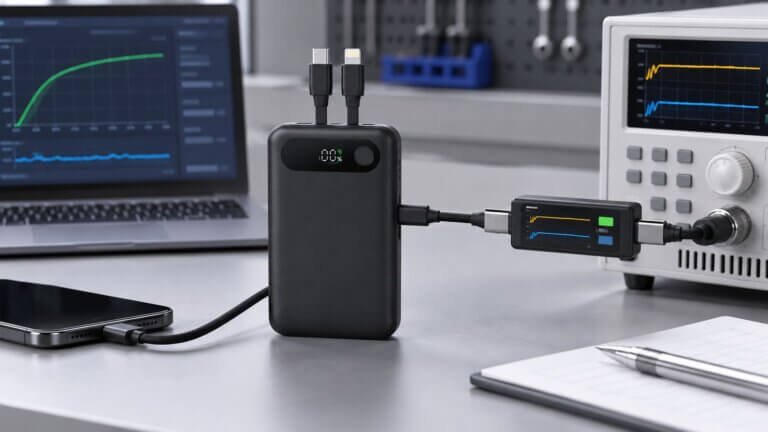 F82-D · 10,000mAh / 3.85V / 38.5Wh
10,000mAh × 3.85V ÷ 1000 = 38.5Wh.
G102 Max · 71.62Wh / 45WWh is stored energy; W is output power. Evaluate both separately.
Continue the Engineering ReviewCell & PACK Selection →
PD & PPS Charging →
Thermal & DC-DC Efficiency →
Product Specification Template → · Certification by Market →
Power Bank Capacity FAQ
How do I convert power bank mAh to Wh?
Multiply nominal capacity in mAh by nominal voltage, then divide by 1000. Example: 10,000mAh × 3.85V ÷ 1000 = 38.5Wh.Why is rated output capacity lower than nominal mAh?
The battery stores energy at cell voltage while USB output is delivered at a regulated output voltage. DC-DC, PCB, cable and thermal losses reduce usable output.Should I compare power banks by mAh or Wh?
Use Wh to compare stored energy, especially when nominal voltages differ. Review rated output and test conditions separately.Can I use a fixed 80% efficiency for rated capacity?
Only for early estimation. Production claims should use measured data because efficiency changes with design, load, voltage, cable and thermal conditions.What should a buyer ask the supplier to provide?
Ask for nominal capacity, nominal voltage, Wh, cell/PACK identity, rated output or output-energy test data where applicable, test conditions and exact SKU/revision confirmation.Additional mAh, Wh & Rated Capacity FAQ
Why can two 10,000mAh power banks have different Wh values?
Because mAh must be interpreted with nominal voltage. A 10,000mAh battery at 3.85V stores more Wh than the same mAh value at 3.7V.
What is rated output capacity?
Rated output capacity describes usable capacity or energy delivered at a specified output voltage and test condition after conversion losses, rather than the nominal cell-side mAh alone.
Why should test conditions be stated with rated capacity?
Output voltage, current, battery state, temperature and converter efficiency can all change measured usable energy, so results are only comparable when the test basis is clear.
Does a higher mAh number always mean longer runtime?
Not by itself. Runtime also depends on nominal voltage, conversion efficiency, device load, charging protocol and the actual usable energy delivered.
What should packaging show to avoid misleading capacity claims?
Keep nominal capacity, Wh and any rated output capacity clearly separated and ensure the printed values match the tested and approved SKU.
Need to Verify a Capacity Claim?
Send the nominal capacity, nominal voltage, rated output basis and target SKU. ZEROSET can help distinguish stored energy from usable output and identify the required test basis.