
Power Bank Inventory Aging: Storage, State of Charge and Reinspection Gates
When does stocked inventory need another check before sale or shipment? Use a documented release gate tied to the exact SKU, storage history and channel.
There is no universal number of months after which every power bank becomes unsellable. A buyer should set a product-specific reinspection trigger using cell and finished-unit specifications, date and lot records, storage temperature, state-of-charge history, and the destination channel. Before release, inspect the packaging and unit, then run a documented electrical and functional sample check against the approved SKU baseline. Escalate any abnormal heat, swelling, damage or charging behavior.
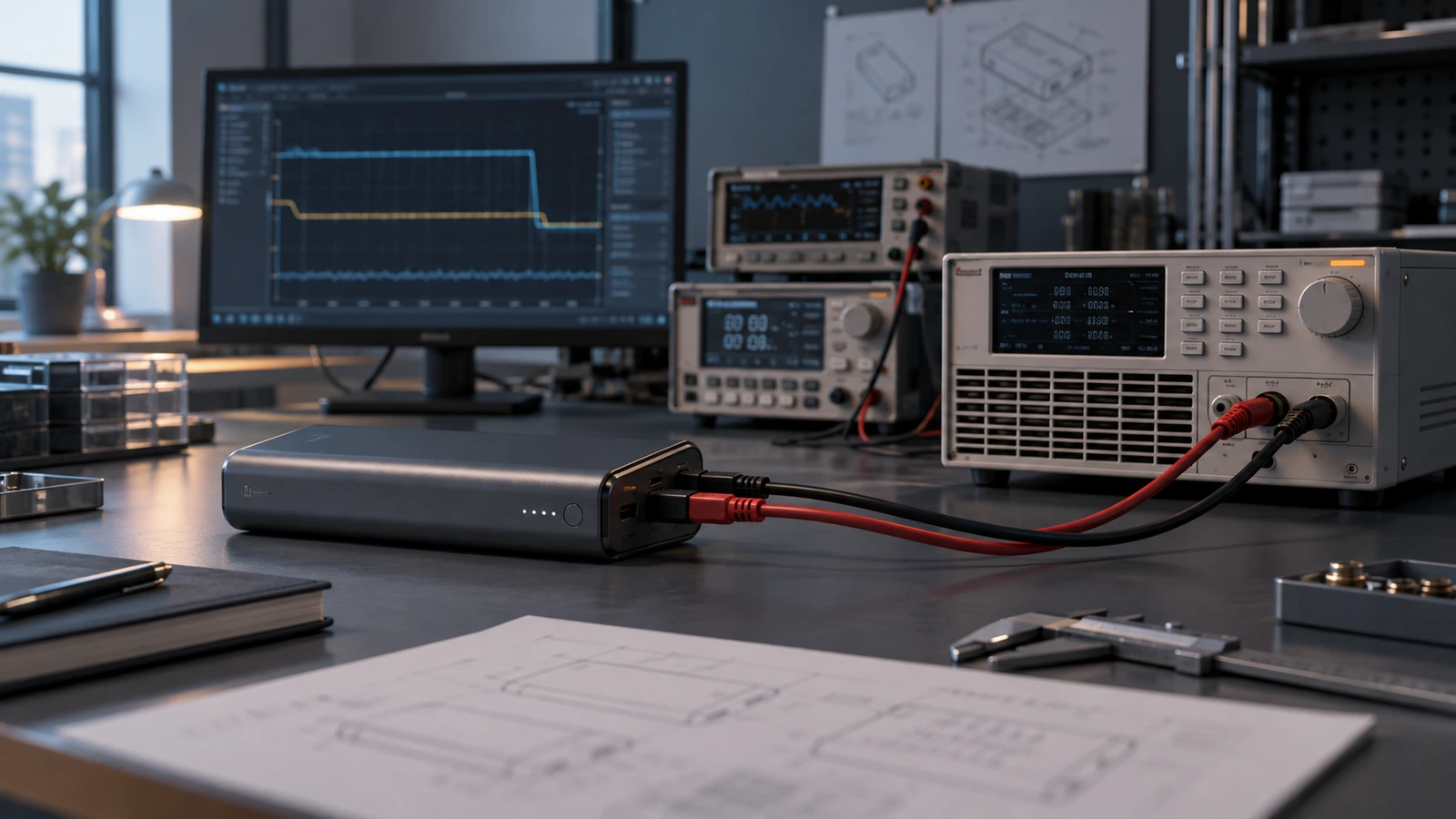
Inventory age is only a starting signal. Lithium-ion batteries can lose usable capacity with calendar time, and that change depends on temperature and state of charge. A lot held in controlled conditions and a lot exposed to unrecorded heat should not receive the same release decision merely because both have the same production date. NREL describes the role of storage conditions in battery aging.
Set three gates before the first carton enters storage
1. Identify the exact inventory
Record finished SKU, cell and pack revision, production lot, pack date, approved sample version, packaging artwork version and quantity. Keep the lot-to-carton link intact when inventory moves between factories, warehouses and fulfillment providers. If a label cannot be mapped back to the approved configuration, quarantine the affected stock until identity is resolved.
2. Define storage controls with the supplier
Ask the cell and power-bank engineering teams to specify their approved temperature range, initial state of charge, measurement method, recheck interval and recovery or disposal rule for the exact design. A display percentage is not a substitute for a validated measurement. Do not turn an air-shipment charge limit into a universal warehouse storage target: transport and storage are different decisions. IATA’s current guidance treats power banks offered for air transport as UN 3480 and applies the relevant packing-instruction charge limits.
3. Release by evidence, not by calendar alone
Choose a sampling plan and acceptance criteria before testing. Compare external condition, labels, charge initiation, output behavior and measured capacity against the approved finished-unit specification. Record the tester, method, instrument, sample IDs and failures. A failed or suspicious sample should trigger lot-level containment and an engineering disposition rather than a quiet top-up charge.
Original inventory-aging decision matrix
| Inventory signal | Minimum buyer action | Release decision |
|---|---|---|
| Age below the agreed trigger; complete storage records | Confirm carton identity, seals, environment log and planned shipment mode | Release only under the approved routine inspection plan |
| Age reaches the SKU-specific recheck trigger | Sample finished units; check appearance, state of charge, charging, output and capacity against approved limits | Release only with signed reinspection record |
| Heat excursion, missing logs, unknown lot or repack | Hold stock; investigate exposure and trace affected cartons | No release until written engineering and quality disposition |
| Swelling, unusual heat, leakage, damaged case or abnormal behavior | Isolate and escalate under the site safety procedure | No sale or ordinary return shipment; use specialist handling rules |
The matrix is a buyer workflow, not a fixed standard or a claim that ZEROSET has tested a particular lot. Its intervals and limits must come from the approved SKU plan.
What to put in the reinspection file
- Approved SKU specification, cell/pack revision and finished-unit acceptance criteria.
- Production date, lot and carton traceability, receipt dates and storage movement history.
- Temperature or environmental log, excursions and storage state-of-charge records.
- Sampling rationale, unit IDs, equipment, measured results and photographs of defects.
- Quality disposition, rework or recharge authorization, retest and release signature.

Hypothetical buyer scenario: seasonal inventory
A retailer orders a holiday range early, then delays launch. Some cartons remain in a climate-controlled warehouse; others move to a fulfillment center whose temperature history is incomplete. The buyer does not declare both lots fit simply because the product is still sealed. They separate the lots, verify identity and history, sample to the approved specification, and ask engineering to dispose of any abnormal result. This scenario illustrates a decision path; it is not a ZEROSET customer case or measured outcome.
Useful ZEROSET routes
Compare power bank platforms, review factory and quality capabilities and read the engineering guides. A buyer with an identified lot can send its SKU, quantity and release date through Get Quote.
Frequently asked questions
Is there one safe shelf-life number for all power banks?
No. The trigger should be established for the exact cell, pack, finished product and storage environment, then documented in the buyer-supplier quality plan.
Does sealed packaging prove an old unit is saleable?
No. The box can look intact while capacity, state of charge or charging behavior has changed. Use the agreed inspection plan.
Should every older unit be recharged before sale?
No. Recharging requires an approved procedure and evidence that the lot remains safe and within specification. A suspicious unit needs containment first.
Can the display percentage be the sole state-of-charge check?
No. The display is a user interface. Use the approved measurement method for the exact SKU.
What if the warehouse temperature log is missing?
Hold the affected stock, reconstruct the exposure as far as possible, and request a written engineering and quality disposition before release.
Does the 30% air-transport rule define storage charge level?
No. Air-transport limits belong to the applicable shipping rules; storage targets come from the cell and product instructions.
What information should the buyer send for a reinspection proposal?
Send the exact SKU, lot and carton IDs, production date, quantity, storage history, target market and proposed ship date.
Sources and scope
- NREL: battery lifespan and storage conditions
- IATA: 2026 lithium battery guidance, including power banks
- PHMSA: lithium battery transport hazards and shipper resources
Turn aged stock into a documented release decision
Share the SKU, age, storage record and destination with ZEROSET. We can discuss an appropriate evidence list and reinspection route without assuming a universal shelf-life limit.