
Power Bank CAPA, Root Cause Analysis & 8D Checklist
A quality reference for handling power bank nonconformities through containment, root-cause analysis, corrective action, verification, 8D documentation and prevention of recurrence.
A corrective action is not complete when the symptom disappears.
Contain the affected lot, identify the real cause, define a controlled corrective action, verify effectiveness and update the process or design controls needed to prevent recurrence.
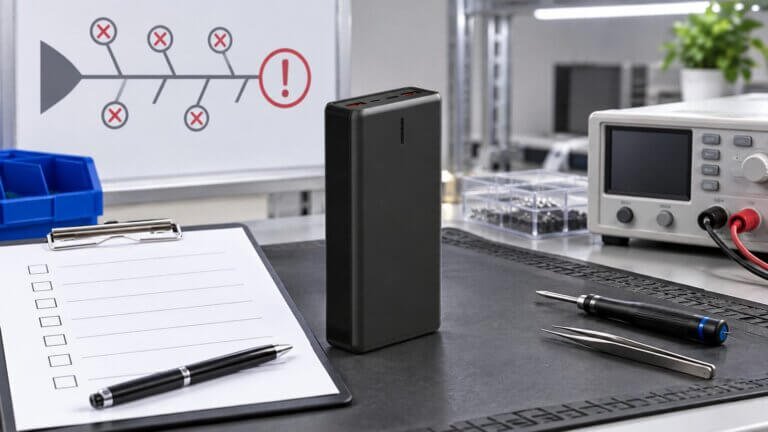
CAPA / 8D — 4 Practical Checks
Record the exact SKU, issue owner, affected lot, evidence, verified cause, corrective action, validation result and closure status.
 01 · Problem Definition & Containment
Best for: defining the failure and protecting current production or customers.
SKU / issue owner: ___
Failure mode / where / when: ___
Affected lot / quantity: ___
Hold / quarantine / sorting: ___
Temporary inspection / protection: ___
Status: Contained / Recheck / Open
Best for: proving why the defect occurred and why existing controls missed it.
Occurrence cause: ___
Escape / detection cause: ___
Evidence / reproduction: ___
Known-good comparison: ___
Alternative causes eliminated: ___
Decision: Proven / Rework Analysis / Open
Best for: confirming the permanent fix works without creating new risk.
Design / component / process change: ___
Inspection / document change: ___
Validation sample / lot: ___
Before / after evidence: ___
Effective-lot result: ___
Decision: Effective / Conditional / Retest
Best for: locking the fix into controlled production and deciding closure.
BOM / drawing / firmware update: ___
WI / control-plan update: ___
Supplier / incoming control: ___
Similar-SKU review: ___
Old-stock disposition: ___
Closure: Closed / Conditional / Open
Open Engineering Change Control →
Rule: containment or rework is not closure. Root cause must be supported by evidence, the escape point must be addressed, and corrective action must be validated on the effective production state before CAPA / 8D is closed.
CAPA / 8D Closure Decision & Next Gate
Open CAPA / 8DRepeat defect, customer escape or systemic failure requires structured ownership and containment.
Keep OpenOccurrence cause, escape cause or effectiveness evidence is still unverified.
ConditionalThe corrective action is implemented but effective-lot or recurrence-prevention evidence is still being confirmed.
Close / ReleaseCauses are verified, controls are updated and effectiveness is demonstrated on the released production state.
IPQC → · Production QC → · Pre-Shipment → · Factory Evidence →
Power Bank CAPA & 8D FAQ
When should a power bank quality issue trigger CAPA or 8D?
Use CAPA or 8D when a defect is recurrent, systemic, safety-related, customer-relevant or likely to escape again unless the underlying cause is removed.
What is the difference between containment and corrective action?
Containment protects current production or customers from the immediate defect. Corrective action removes or controls the verified root cause so the issue does not recur.
What evidence is needed for root-cause analysis?
Use defect data, affected-lot information, process records, component history, test results, reproduction evidence and cause-and-effect analysis tied to the exact SKU and revision.
Why should the escape point be analyzed separately?
The occurrence cause explains why the defect happened. The escape point explains why existing controls failed to detect it before shipment or customer use.
What should a CAPA action plan include?
Define the action, owner, deadline, affected lots or revisions, required validation and the evidence needed before closure.
How should a component-related root cause be handled?
Identify the exact component, source and affected lots, contain related inventory, review the BOM or approved-source rule and validate the corrected configuration.
How should process-related CAPA be validated?
Repeat the affected process under the corrected conditions and verify through measurable output, defect-rate or inspection evidence that the issue is controlled.
Can rework alone close an 8D?
No. Rework fixes affected units but does not prove the root cause is understood or that recurrence is prevented.
What should be updated after a successful corrective action?
Update the relevant work instructions, control plan, inspection criteria, BOM, training or change-control documents so the new control becomes part of the released process.
When can a CAPA or 8D be closed?
Close it only after the cause is supported by evidence, corrective action is implemented, effectiveness is verified and the affected production state is controlled.
Need to Structure a CAPA or 8D Response?
Use a controlled problem statement, lot traceability, root-cause evidence and effectiveness verification so corrective action closes the real failure mode.