
Power Bank In-Process Quality Control (IPQC) Checklist
An in-process quality checklist for power bank assembly, covering battery and PCBA handling, soldering, cable routing, fastening, functional checks, appearance controls, traceability and process deviations.
IPQC catches process drift before it becomes a finished-lot problem.
Use the approved work instructions, BOM, golden sample and test requirements to verify assembly steps and identify deviations while the product is still in process.

In-Process Quality Control — 4 Practical Checks
Record the exact SKU, production lot, released revision, station owner, result and disposition. Use project-specific process limits and released work instructions.


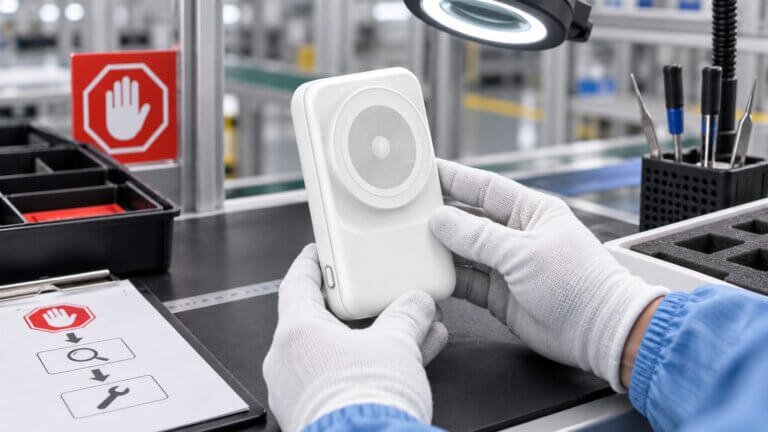 01 · Build Identity & First Piece
Best for: confirming the line starts from the released product state.
Model / SKU / production lot: ___
BOM / PCBA / firmware: ___
Approved material lots: ___
Fixture / equipment setup: ___
First-piece fit / charge / function: ___
Decision: Continue / Recheck / Hold
Best for: controlling firmware, cable, soldering and assembly inputs.
Programming version: ___
Cell / PACK polarity & insulation: ___
Cable / connector revision: ___
Solder / weld / flex route: ___
Torque / adhesive / cure state: ___
Decision: Continue / Correct / Hold
Best for: detecting drift after first-piece approval.
Power-on / I-O charging: ___
PD / PPS / cable / mechanism: ___
Protection indicators: ___
Gap / flushness / alignment: ___
Cosmetic / patrol trend: ___
Decision: Continue / Stop / Recheck
Best for: controlling defects before more units are affected.
Defect / NCR ID: ___
Affected quantity / time window: ___
Stop / hold / segregation: ___
Approved rework / re-inspection: ___
Lot / station traceability: ___
Release: Restart / Conditional / Hold
Rule: IPQC must verify both the product and the process. If setup, firmware, material, tooling or work instructions drift from the released state, stop, contain and correct before continuing production.
IPQC Line Decision & Next Control
ContinueFirst piece is approved and the released process remains stable.
Stop / HoldWI, fixture, firmware, material or setup no longer matches the released state.
Stop / ContainA defect trend or yield drop appears; bound affected units before restart.
Escalate CAPA / 8DThe issue repeats, escapes correction or shows the existing control is ineffective.
IQC → · Production QC → · CAPA / 8D → · Factory Evidence →
Power Bank IPQC FAQ
What is IPQC in power bank manufacturing?
In-Process Quality Control verifies that the released materials, setup and assembly process remain under control while power banks are being built.
Why is first-piece approval important?
The first piece confirms that the line is using the correct model, revision, materials, firmware, tooling and settings before the rest of the lot continues.
What should IPQC check during assembly?
Typical checks include part identity, soldering, connector alignment, cable routing, housing fit, firmware, display function, charging behavior and process workmanship.
How should IPQC respond to process drift?
Stop or contain the affected production, identify when the drift started, correct the setup or process and recheck affected units before continuing.
Why should rework be controlled during IPQC?
Uncontrolled rework can create hidden defects or inconsistent units. Use an approved method, record affected serial or lot information and repeat the required inspection afterward.
What records should IPQC keep?
Record SKU, revision, lot, station, first-piece status, patrol results, defects, rework, disposition and the person responsible for the check.
How should firmware be controlled during production?
Use the released firmware version, verify programming status and prevent mixed revisions within the same production lot unless an approved change is documented.
What is the relationship between IPQC and work instructions?
IPQC checks whether the line follows the released work instructions. If the actual process differs from the approved instruction, the discrepancy should be reviewed before continuing.
How should recurring in-process defects be handled?
Escalate repeated defects for root-cause analysis, corrective action and possible CAPA or 8D instead of repeatedly reworking units without solving the source problem.
What happens after IPQC confirms a stable build?
Finished units proceed to production QC and final inspection, where function, workmanship, labeling, packaging and lot release are checked.
Need an IPQC Checklist for a Power Bank Line?
Use the approved BOM, sample and process instructions as the inspection basis so assembly drift can be caught before final inspection.