Shopify Power Bank Brand: Selecting an OEM SKU, Packaging and Returns Workflow
Connect the product promise to fulfillment, warranty and the real cost of returns.
A Shopify power-bank brand should launch a sharply defined SKU, test it on target devices and prepare its return route before driving paid traffic. The product page, box, manual and support team must agree on capacity, output, compatibility and accessories. Include carrier and hazardous-goods handling in fulfillment planning. Track why units return so the next OEM order fixes product, copy or shipping problems.
What current evidence tells a buyer
The U.S. Census Bureau estimated online retail at 17.1% of retail sales in Q2 2026. NRF projected 19.3% of online sales across all retail categories would be returned in 2025, with 82% of consumers considering free returns important. These are broad channel measures, not a power-bank return rate.
A direct-to-consumer brand owns the whole promise: product images, arrival condition, customer instructions, returns and warranty. A 10K fast-charge model may be a simple first product, but it needs a distinct buyer reason beyond 'fast charging.' Give the page a tested device scenario and a clear port diagram. A premium color or gift box helps only if the charging behavior and delivery experience earn repeat trust.
The cited market figures measure their stated channels or populations. They do not prove sales or demand for this exact power-bank SKU.
One hero SKU, three linked files
The first launch can have one platform and color variants, but it needs coordinated product, fulfillment and service documentation.
| Buying role | Supplier brief | Approval gate |
|---|---|---|
| Product file | Exact Wh, ports, output profiles, test devices and revision | Approve sample and retain the signed specification. |
| Storefront file | Photos, dimensions, compatibility, contents and support answer | Match every claim to the sample and box. |
| Returns file | Lot, symptom, safe handling and disposition rules | Use return reasons to separate defect from miscommunication. |
Model contribution margin after pick/pack, battery shipping, payment fees, customer acquisition and returns. A good factory price can still fail as a DTC product when the support burden is high.
“The Shopify product page and the unit that arrives must tell the same story.”
DTC lets a brand explain an unusual format in depth, but it also owns every disappointed expectation. A truthful comparison and a clear return path are part of the product.
The unusual challenge is the feedback loop. A refund reason may point to a cable defect, an incompatible phone case or a misleading image. Collect enough item-level detail to choose the right correction.
ZEROSET model and image reference

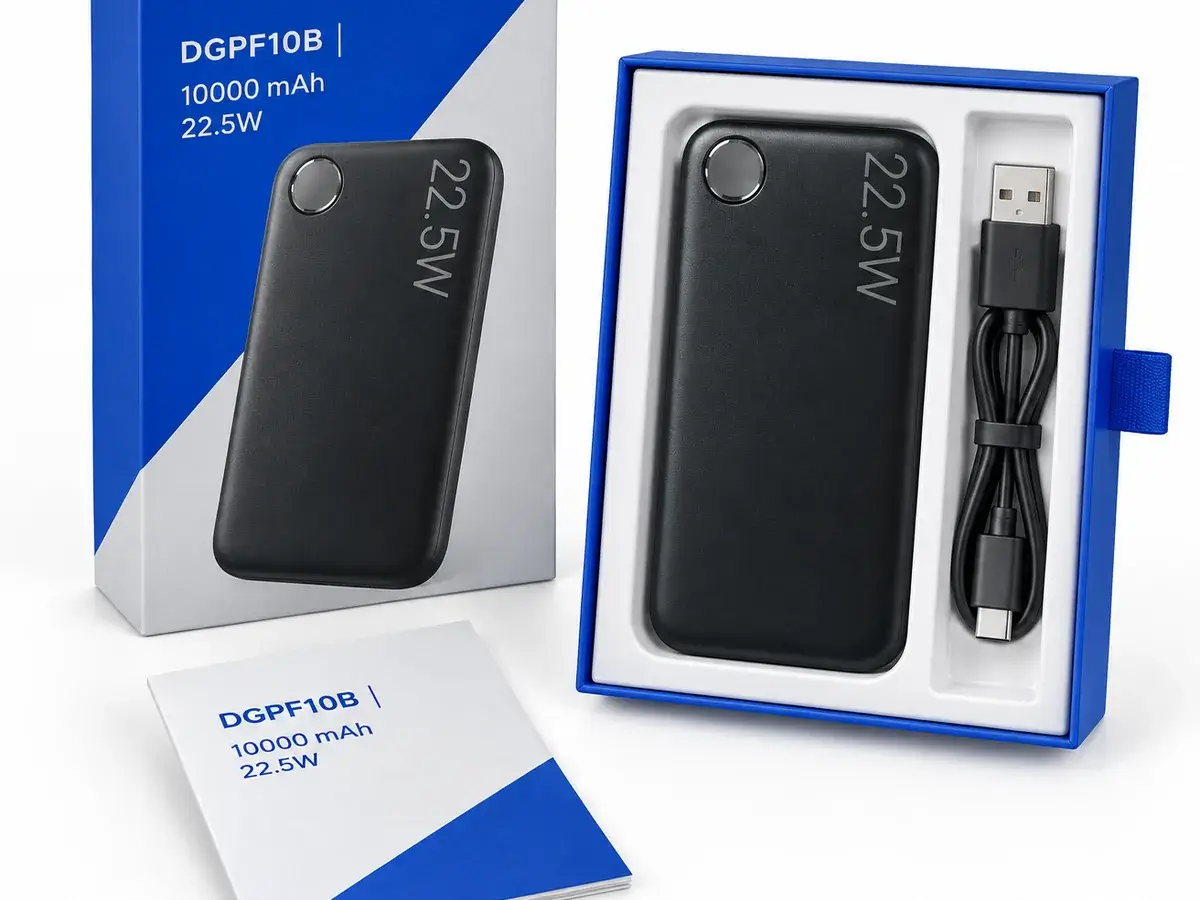
The DIGMA DGPF10B case documents a straightforward 10K / 22.5W format with USB-A, USB-C and a digital display. It provides a good example of how to write a concise specification and photograph the actual ports. The second image depicts a buyer sample review.
The DIGMA example is a format reference; it does not represent Shopify sales or a ZEROSET promise of a particular return rate.
Supplier brief and release gates
Use one controlled file for the exact battery, electronics, cable, artwork, destination and sales route. Ask the factory to identify the model revision on every sample and document.
- Choose one buyer job. Define the customer, devices, price and specific reason to select the SKU.
- Test the finished sample. Check real-device charge, heat, indicator, pack contents and shipping protection.
- Write traceable copy. Use a revision ID across PDP, box, manual and customer-support scripts.
- Prepare returns. Set safe handling, symptom capture, refund and warranty paths.
- Feed results back. Compare actual returns, reviews and conversion before reordering or adding colors.
Before signing a purchase order, request quantity tiers, sample approval criteria, packaging and carton details, document ownership, production timing and a written component-change procedure. Review real device performance rather than relying only on brochure specifications.
Frequently asked questions
Should a new DTC brand start with many models?
A focused first SKU can make photos, inventory and support easier to control.
Do general retail return rates predict power-bank returns?
No. They are planning context; use your own SKU-level data.
What must appear on the product page?
Capacity/Wh, output conditions, ports, dimensions, compatibility and box contents.
Can defective batteries be put back into stock?
Do not assume so; use a safe inspection and disposition process.
What causes avoidable support tickets?
Unclear compatibility and accessory expectations often create preventable questions.
What should the factory get from support?
Revision, lot, symptom, device, usage conditions and safe evidence.
Sources and scope
- U.S. Census e-commerce — Q2 2026 channel share
- NRF 2025 Returns Landscape — online returns context
- DIGMA DGPF10B case — model reference
Checked October 2026. The assortment recommendations are sourcing scenarios for 2027 and must be validated with item-level tests, current platform rules and destination requirements.
Send your customer profile, target price, devices and fulfillment route. ZEROSET can prepare one sample and a revision-controlled product file.