Power Bank Packaging Claims: An Exact-SKU Artwork Approval Matrix
How should a buyer approve power bank packaging claims for an exact SKU?
Packaging is a compressed product specification. A front-of-box wattage can travel farther than the qualification that supported it, while an old barcode or model code can break traceability. Artwork approval therefore belongs inside the SKU release process.

Build a claim ledger before design
List every number, icon, compatibility statement and implied benefit on the front, back and side panels. For each, record the source evidence, hardware/firmware revision, test conditions, market, owner and approved wording. Treat QR destinations and retailer copy as extensions of the same claim.
Capacity and Wh statements should follow the approved technical file, not a graphic designer’s assumption. Fast-charge and wireless claims need the named conditions that make them true. An unsupported badge or logo should be removed before the visual proof goes to print.
Check identity and destination together
Match SKU, model, barcode, color, included cable, user guide and carton labels to the approved sample. Ask the importer or local reviewer to confirm address, language, warnings and applicable marking for the destination; do not transplant an EU version onto a UK or Brazil print file by changing a flag.
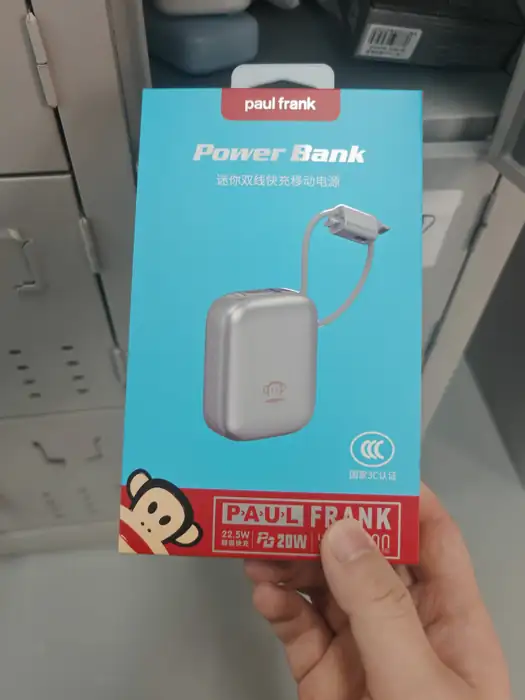
The physical example in the second image is an existing Paul Frank F97 retail box from the ZEROSET media library. It illustrates packaging anatomy only; its visible claims and approvals cannot be reused as evidence for another SKU.
Use a controlled proof and reprint gate
Archive the approved PDF, print sample, revision and signer. Compare the actual pre-production box with the approved file for legibility, color, dimensions and the presence of mandatory information. Include barcode scan and QR destination in that check.
If a component, accessory, importer or claim changes, identify which artwork surfaces are affected. A small technical substitution can force a box revision even when the exterior product looks unchanged.
Buyer approval matrix
| Artwork field | Evidence owner | Approval question |
|---|---|---|
| Power and charging | Engineering test record | Exact port/device conditions stated? |
| Capacity and energy | BOM and technical file | Numbers match the approved SKU? |
| Compatibility/logo | Certification or device matrix | Permission and scope proven? |
| Identity/importer | SKU master and market reviewer | Correct model, contact and market? |
| Print proof | Brand and quality sign-off | Physical box matches approved PDF? |
A buyer scenario
Illustrative buyer scenario: a team copies a successful box layout to a new cable-equipped model. The old front panel says “fast charge” and the side panel depicts an accessory that is not in the new pack. The buyer pauses print, requests a claim ledger and revises both panels to match the approved sample. No actual customer outcome is claimed.
Frequently asked questions
Is packaging just a design approval?
No. It combines product claims, model identity, market information and a physical print proof.
Can one box serve multiple markets?
Only after a market-by-market review of language, markings, importer details and claim scope.
What if the artwork uses a certification logo?
Confirm authorization and exact model scope before using it.
Does a QR code need approval?
Yes. Its destination may carry claims or instructions that must match the SKU and market.
Who signs the final proof?
Assign named technical, regulatory, brand and commercial owners to relevant fields.
What triggers a reprint review?
A changed component, accessory, firmware, claim, importer, language or barcode can.
How do we prevent an old template mistake?
Start from the SKU claim ledger and run a field-by-field proof check.
Primary sources and scope
These sources explain standards or rules; they do not certify any ZEROSET model. Verify the exact SKU, destination and current requirements before making a market claim.