Power Bank Thermal & DC-DC Efficiency Reference
An engineering reference for understanding power bank conversion efficiency and thermal behavior across DC-DC stages, output load, battery current, PCB design, enclosure heat paths and sustained charging performance.
Peak wattage is not the same as sustained performance.
Conversion losses become heat, and that heat interacts with battery current, PCB layout, enclosure structure and ambient conditions. Buyers should validate the complete operating state instead of one headline power number.
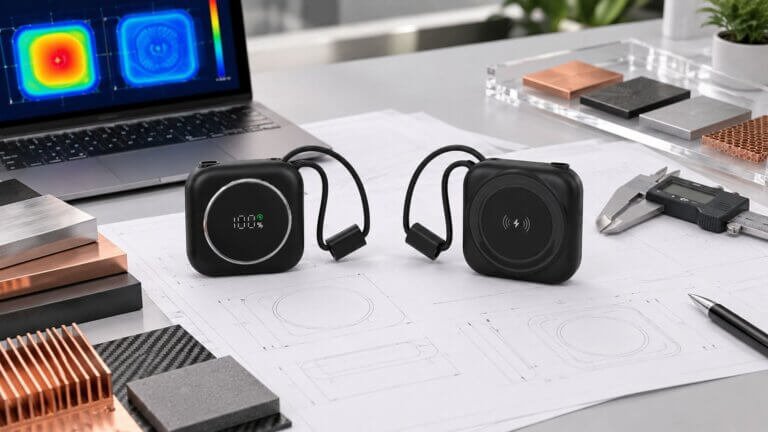
Quick Engineering Review
Separate peak output from sustained performance at a defined operating point.
Operating PointDefine input/output voltage, current, battery state and load before comparing results.Efficiency
Measure input and output power at the same condition; do not use one best-case percentage universally.Temperature
Record hotspots and enclosure temperature over the intended operating duration.Revision State
PCBA, firmware, cable and cell/PACK state must match the tested sample.

Buyer Decision Points
Conversion EfficiencyCompare input and output power at the same voltage, current, battery state and load.Cell & Power Path
Cell current, MOSFETs, inductors, PCB copper and connectors all add loss and heat.Hotspots & Enclosure
Measure component hotspots and enclosure temperature rather than one average reading.Duration & Derating
Confirm the target output can be sustained for the intended duration without thermal derating.

Related Engineering
Cell & PACK Selection →
PD & PPS Charging →
PCB & Power Path →
Product Specification Template →
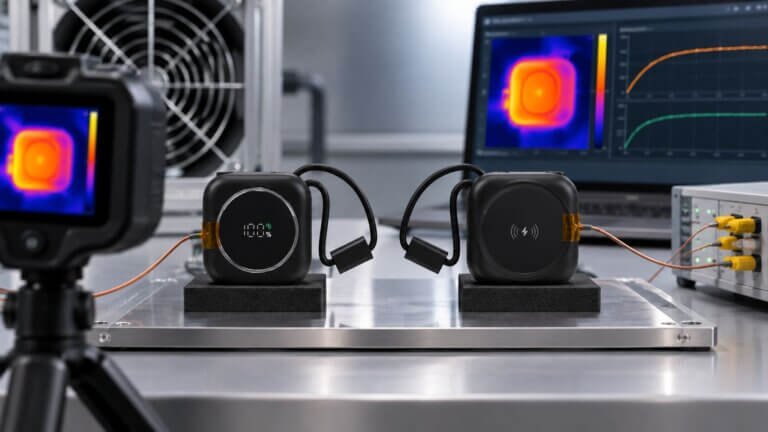
Thermal & Efficiency FAQ
Does peak wattage prove sustained output?
No. Sustained power depends on efficiency, current-path loss, thermal limits and firmware behavior over time.Is one efficiency percentage enough?
No. Efficiency changes with operating point, battery state, load, cable and temperature.Why record ambient temperature and test duration?
Because the same SKU can show different thermal behavior at different ambient conditions and after heat has accumulated.Additional Thermal & Efficiency FAQ
What is DC-DC efficiency in a power bank?
It is the ratio of output power to the electrical power drawn from the battery or input conversion stage at a defined operating point.
Why does lower efficiency create more heat?
Energy not delivered to the output is largely dissipated as heat in the converter, PCB, components, connectors and cables.
What operating points should be checked for efficiency?
Measure representative low, medium and high loads, and include important battery-voltage or charging conditions rather than relying on one peak-efficiency number.
Where do hotspots commonly appear in a power bank?
Hotspots can occur at switching ICs, MOSFETs, inductors, shunts, connectors, cable pads and high-current PCB transitions.
Why should sustained output be tested over time?
Heat accumulates. A unit may deliver peak power initially and then reduce output or reach higher component temperatures after several minutes.
How can enclosure design affect thermal performance?
Material, wall thickness, internal contact, air gaps and component placement influence how heat spreads away from the PCB and battery.
When should thermal testing be repeated?
Repeat or review testing after changes to cells, PCB, power components, firmware, enclosure, cable layout, output power or other items that affect current and heat.
Need to Check Thermal Headroom for a Power Bank Design?
Send the target power, battery configuration, PCB layout constraints and enclosure size. ZEROSET can identify the main validation points for efficiency and sustained-load behavior.