
Power Bank Mechanical Stack-Up & DFM Reference
A DFM reference for power bank mechanical stack-up, covering battery envelope, PCB placement, cable routing, connector position, wall thickness, fasteners, tolerances, thermal clearance and assembly access.
A compact enclosure only works when every layer has space to assemble, cool and survive production tolerance.
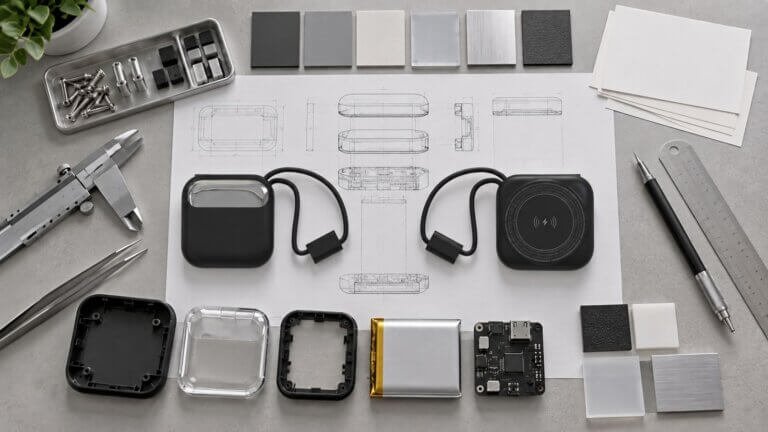
Battery, PCB, ports, cables, magnets, fasteners and housing features compete for the same volume. DFM should verify the complete stack-up before tooling is frozen.

Quick Engineering Review
Confirm the released structure can be assembled repeatedly without hand-adjustment.
Cell EnvelopeControl clearance, support, swelling allowance and separation from hard points.Port Alignment
Check PCB, connector and enclosure openings across production tolerances.Cable / Mechanism
Validate routing, bend path, moving parts, adhesive and strain relief clearance.Assembly Sequence
Define fastening, adhesive access, inspection points and rework limits before release.
Buyer Decision Points
Cell & PCB StackControl support surfaces, clearances and the relationship between cell / PACK, PCBA, ribs and fasteners.Ports & Connectors
Connector position and enclosure openings must align without forced assembly.Mechanism, Adhesive & Fasteners
Moving cable paths, screws, clips and adhesive areas need practical assembly clearance.Tolerance & Assembly
Review accumulated tolerance, inspection access and repeatability before tooling or release.

Related Engineering
Cell & PACK Selection →
Built-In Cable Loss →
PCB & Power Path →
BOM & Change Control →
Custom Development →

Mechanical DFM FAQ
Is an appearance sample enough for mechanical approval?
No. A production-intent sample should also prove internal stack-up, tolerances, assembly access and repeatability.Why does tolerance stack matter?
Small dimensional variations can accumulate and affect port alignment, compression, clearances and assembly force.When should DFM be rechecked?
When the cell, PCB, connector, cable mechanism, enclosure, fastening or other structure changes enough to affect fit or assembly.Additional Mechanical Stack-Up & DFM FAQ
What is mechanical stack-up in a power bank?
Mechanical stack-up is the combined arrangement of battery, PCB, connectors, cables, wireless coils, displays, fasteners, ribs and housing clearances inside the enclosure.
Why is stack-up especially important in thin power banks?
Thin products have very little spare internal height. Small changes to cell thickness, PCB components, ribs or adhesive can create interference or assembly stress.
What should DFM review before tooling release?
Review parting lines, draft, wall thickness, ribs, bosses, fasteners, tolerance, assembly sequence, connector access, cable routing, battery clearance and expected manufacturing variation.
How can connector position create mechanical risk?
USB-C, USB-A or direct-plug connectors must align with housing openings and withstand insertion forces. Poor tolerance control can cause scraping, misalignment or stress on the PCB.
Why should battery swelling allowance be considered?
Battery thickness can vary over life and use. The enclosure and compression strategy should avoid unsafe pressure while maintaining product fit.
How should cable-routing space be validated?
Check bend radius, strain relief, connector position, moving paths for retractable mechanisms and whether the cable interferes with the battery, PCB or housing.
What should be rechecked after changing the enclosure material or thickness?
Review fit, stiffness, thermal behavior, fastening, tolerances, drop performance and any dimensions that affect internal compression or connector alignment.
Need a Mechanical DFM Review Before Tooling?
Send the product envelope, battery, PCB, ports, cable routing and key industrial-design constraints. ZEROSET can review the stack-up and identify assembly or tolerance risks before tooling release.