Inside the G-TIDE Power Bank Range: Three Products Built Around Three Charging Habits
Slim 01, Multi X1 and Traveler 1 share a brand, but each one was built around a different way people charge.
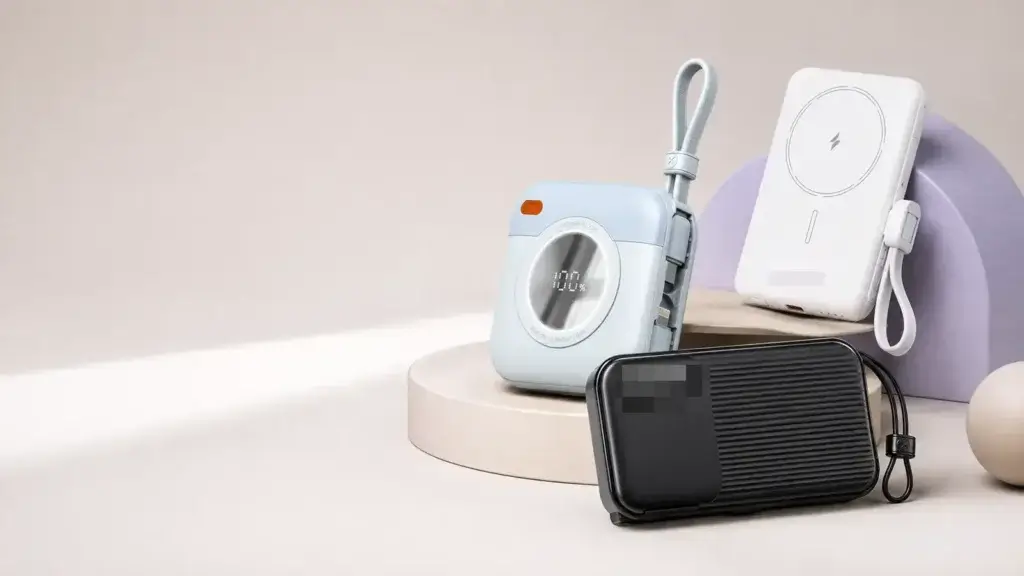
Put the three models side by side and the range makes sense almost immediately.
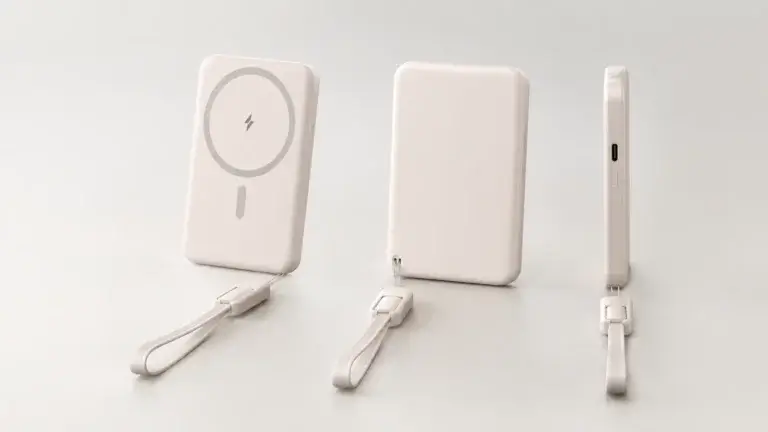
Slim 01 is the smallest of the three: a 5,000mAh magnetic power bank with wireless charging and an integrated USB-C cable.
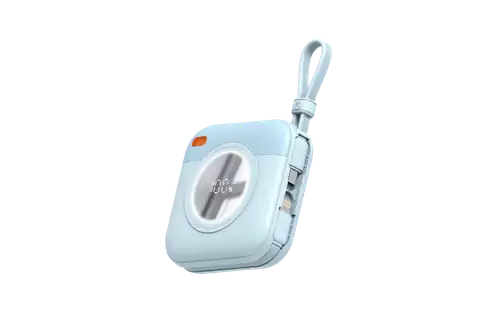
Multi X1 moves up to 10,000mAh and adds two built-in cables while keeping wireless charging.
Traveler 1 stays in the 10,000mAh class, but changes the idea completely by adding AC input, allowing the power bank itself to plug directly into a wall outlet.
Behind the retail names are three ZEROSET product platforms: F91-D, F86-D and F82-C.
The packaging files from these projects show how those platforms were developed into three G-TIDE products with different functions, colors, packaging and positions in the range.
This page focuses only on Slim 01, Multi X1 and Traveler 1.
It is not intended to suggest that ZEROSET produces every G-TIDE power bank.

The three models at a glance
Short answer: ZEROSET project files connect three market-facing G-TIDE power bank models to three production platforms: F91-D → Slim 01, F86-D → Multi X1, and F82-C → Traveler 1. Together they cover three different retail jobs: slim magnetic carry, multifunction everyday charging, and AC-integrated travel charging.
The important difference is not simply 5,000mAh versus 10,000mAh.
Each product gives the customer a different reason to buy it.
Same brand, three different reasons to buy
Slim 01 is the easiest model to carry.
G-TIDE currently lists it with a 5,000mAh battery, 20W wired charging and wireless output of up to 15W.
Multi X1 is the everyday step-up.
It combines a 10,000mAh battery with built-in cables, wired fast charging and wireless charging.
Traveler 1 is the travel-oriented option.
It also carries a 10,000mAh battery, but its defining feature is the ability to recharge directly from a 100–240V wall outlet.
That distinction is important.
Multi X1 and Traveler 1 sit in the same capacity class, but they are not competing for exactly the same use.
Multi X1 is for someone who wants fewer loose cables in a daily bag.
Traveler 1 is for someone who wants to leave a separate wall charger at home.

G-TIDE Slim 01: F91-D Turned Into a 5,000mAh Magnetic Retail Product
The ZEROSET F91-D platform sits behind the G-TIDE Slim 01 project.
G-TIDE currently specifies Slim 01 with a 5,000mAh / 19.35Wh lithium-polymer battery.
Wired charging reaches up to 20W.
Wireless output reaches up to 15W.
The product also includes bidirectional USB-C and an integrated Type-C cable.
None of these features is unusual on its own.
What makes the product work is how they fit into a small body.
The cable stays with the power bank instead of becoming another item to carry.
The magnetic charging surface gives the user another way to charge without adding a second loose cable.
And because the product is relatively small, its appearance matters more than it would on a large, purely functional battery pack.
G-TIDE sells Slim 01 in black, white, pink, purple and light blue.
That turns one hardware platform into a small color family rather than a single technical SKU.


Five colors give Slim 01 more shelf presence
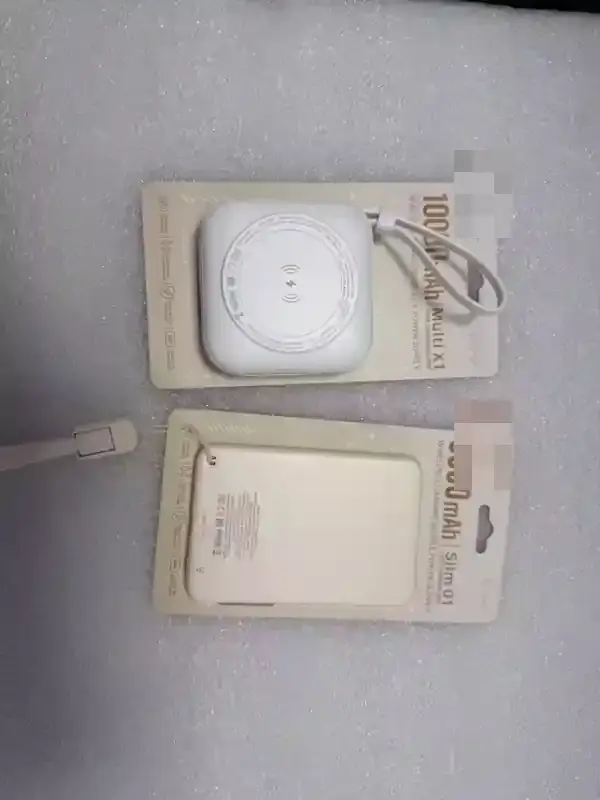
The supplied Slim 01 packaging artwork uses an 89 × 159mm hanging card made from 400gsm paper with four-color printing.
The packaging leaves most of the product visible.
That suits a small accessory because the customer can immediately see the size, color and basic shape instead of relying entirely on a printed product image.
The front does not need to explain every specification.
The brand, model, capacity and main charging features do most of the work.
There is also a production detail that is easy to overlook.
Once the same model is offered in five colors, the housing, cable, print and surface finish all need to look like they belong together.
A slightly mismatched cable or inconsistent surface tone is much more noticeable on a simple product with large uninterrupted surfaces.
Good CMF execution is therefore part of the finished product, not something added after the engineering is complete.
Multi X1: built-in cables do the heavy lifting
The G-TIDE Multi X1 project is based on the ZEROSET F86-D platform.
G-TIDE currently lists the product with a 10,000mAh / 38.5Wh battery.
Its current global specification shows wired fast charging of up to 22.5W and wireless output of up to 15W.
The unit also includes bidirectional USB-C together with built-in Type-C and iPhone-compatible cable functions.
Multi X1 is not simply a larger Slim 01.
The useful part of this model is the number of everyday charging situations it can cover without asking the user to carry another cable.
The built-in cables stay inside the body when they are not needed.
Wireless charging remains available.
The circular front section also gives Multi X1 a noticeably different appearance from Slim 01.
So even before a customer reads the specifications, the two models do not look like the same product in different capacities.
One specification detail is worth noting.
The supplied Multi X1 packaging artwork uses a 20W fast-charging claim, while G-TIDE’s current global product page lists 22.5W Max.
That points to a version or market update.
For production projects like this, the exact specification should therefore always be confirmed against the final market version rather than assumed from an older artwork file.


More functions do not require more words on the front
Multi X1 uses the same 89 × 159mm hanging-card format as Slim 01.
The material is again 400gsm paper with four-color printing.
But the product itself has more to explain.
There are multiple charging methods, integrated cables, wireless charging and a higher capacity.
It would be easy to cover the front of the card with icons.
The artwork avoids that.
The front keeps the brand, model, capacity and main charging message easy to scan.
More detailed technical and safety information moves to the back.
That is usually the better approach for retail packaging.
The front should help someone understand the product in a few seconds.
The back can answer the questions that come after that first impression.

Traveler 1: the wall plug changes the product
Traveler 1 is based on the ZEROSET F82-C platform.
G-TIDE currently specifies the product with a 10,000mAh / 38.5Wh lithium-polymer battery.
It supports 100–240V AC input.
It also includes USB-C input, built-in Type-C and iPhone-compatible cable outputs, plus USB-A output.
The body measures approximately 116 × 63.5 × 28.7mm.
The AC function is the feature that changes how the product is used.
There is an important distinction between wall mode and battery mode.
When Traveler 1 is plugged into a wall outlet, G-TIDE lists adapter output at 5V/2A.
The higher output figures apply when the unit is being used as a portable power bank.
The built-in cables support up to 20W output.
USB-A supports up to 22.5W output.
Keeping those two modes separate makes the specification much easier to understand accurately.
For the user, the advantage is straightforward.
Traveler 1 can recharge itself directly from a wall outlet.
There is no need to bring another wall charger just to recharge the power bank.
Once it leaves the wall, it works as a normal portable power bank through its built-in cables and USB outputs.
That is enough to give Traveler 1 its own place in the range even though Multi X1 uses the same 10,000mAh capacity class.


From factory platform codes to products people can actually understand
F91-D, F86-D and F82-C are useful names inside engineering, sourcing and production.
They mean very little to somebody standing in front of a retail shelf.
The customer-facing product begins after the platform has been selected.
That includes deciding which functions are needed, which features should be removed, how many colors make commercial sense, what the product should be called and what the packaging needs to communicate first.
The model names, colors, feature combinations and packaging solve the retail problem.

The packaging changed because the products changed
The three projects belong to the same G-TIDE product family, but they were not forced into identical packaging.
Slim 01 uses a compact hanging card.
That makes sense for a small product where color and size are part of the appeal.
Multi X1 keeps the hanging-card format, but the layout has to communicate more functions and a higher capacity.
Traveler 1 moves to a larger 164 × 90 × 41mm retail box.
The larger format gives the AC plug, built-in cables and product orientation more room.
It also offers more physical protection for a product with a different structure.
Packaging development is rarely just a graphic-design exercise.
Product dimensions affect it.
Cable placement affects it.
Barcode areas affect it.
Compliance text affects it.
Local-language requirements affect it.
Shipping protection affects it.
A brand family should still look related on the shelf, but forcing every product into exactly the same packaging structure can create more problems than it solves.

What we can see in the Latin American market
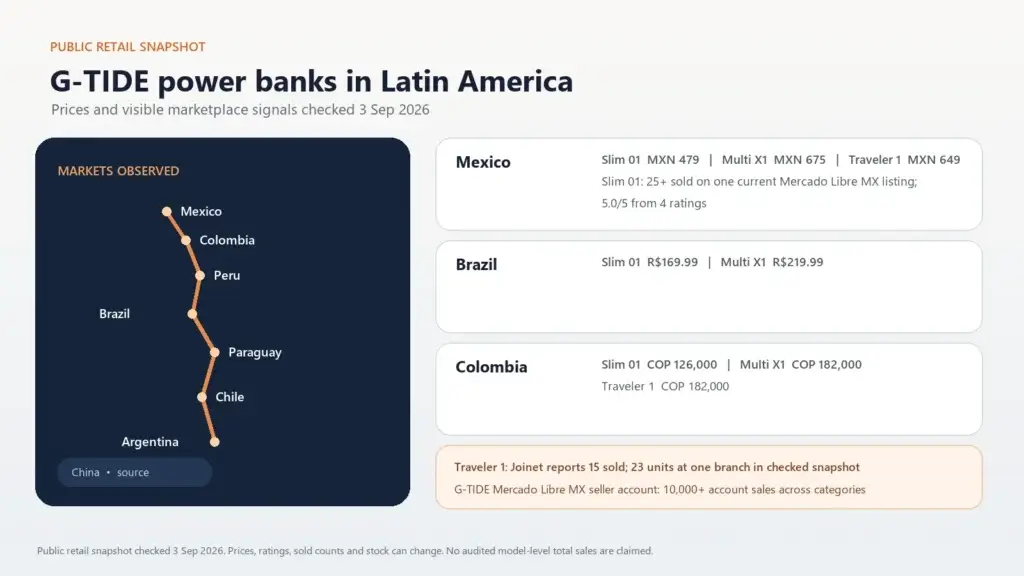
G-TIDE does not publish audited model-level sell-through for Slim 01, Multi X1 or Traveler 1, so this case does not invent a total sales number. Instead, it uses point-in-time public retail evidence checked on 3 September 2026.
Brand reach: G-TIDE’s global website shows Store Distribution entries for Mexico, Brazil, Peru, Paraguay, Colombia, Chile, Argentina and China. Its public product range includes Slim 01, Multi X1 and Traveler 1.
Slim 01
G-TIDE Mexico lists Slim 01 at MXN 479. A current Mercado Libre Mexico Slim 01 listing shows 25+ sold, a 5.0/5 rating from 4 ratings, and a G-TIDE MercadoLíder seller account with 10,000+ seller-account sales. Brazil retail evidence shows Slim 01 at R$169.99 on Magazine Luiza. Falabella Colombia listings show approximately COP 126,000.
Multi X1
G-TIDE Mexico lists Multi X1 at MXN 675. Magazine Luiza lists Multi X1 at R$219.99 in Brazil, while Falabella Colombia lists variants at approximately COP 182,000. The reviewed retail snapshots consistently place Multi X1 above Slim 01 in price within the same market.
Traveler 1
G-TIDE Mexico lists Traveler 1 at MXN 649. Joinet publicly reports 15 sold for its Traveler 1 SKU and showed 23 units at one branch when checked. Falabella Colombia lists Traveler 1 at approximately COP 182,000.
Evidence boundary: retailer prices, stock, ratings and sold counts can change. A listing-level sold count belongs only to that listing. Seller-account sales cover all categories and are not model sales. No audited G-TIDE brand-wide or model-wide sales total is claimed.


Sources & Data Methodology
Market-data methodology: this page separates internal project evidence from public market evidence. Internal packaging files establish the project mapping F91-D → Slim 01, F86-D → Multi X1 and F82-C → Traveler 1. Public product specifications are checked against G-TIDE’s current website. Retail snapshots are checked against G-TIDE Mexico, Mercado Libre Mexico, Joinet, Magazine Luiza and Falabella Colombia.
How to read the numbers: prices are local channel snapshots; sold counts are listing-specific unless explicitly identified as seller-account metrics; stock is a point-in-time observation. Separate channel figures are never added together to create an artificial total-sales figure.
Public source families checked 3 Sep 2026: g-tide.com, gtidemexico.com, mercadolibre.com.mx, joinet.com, magazineluiza.com.br and falabella.com.co.
What Brands Can Learn From the G-TIDE Power Bank Range
A single model can prove that a supplier can execute one SKU. A three-platform family demonstrates a broader capability: magnetic wireless, dual-cable multifunction and AC travel architectures can be developed under one customer brand without collapsing into the same product.
For brands building a range, the practical lessons are simple:
- Build around user jobs, not only capacity. Multi X1 and Traveler 1 are both 10,000mAh but solve different problems.
- Use mature platforms to create branded market products. Platform codes stay inside engineering; customer model names and packaging own the retail story.
- Keep functions visible. Magnetic areas, cable storage, displays and AC plugs are easy to understand without long copy.
- Let packaging follow the product. Slim hang cards and a larger travel box can belong to the same brand.
- Design color as a family. CMF can create assortment depth without creating a completely new structure for every SKU.

Why This Represents ZEROSET’s OEM/ODM Capability
ZEROSET is a Dongguan-based power bank design and manufacturing company established in 2014. The current company profile lists a 6,000+ m² facility, 150+ employees, 5+ production lines, 10 in-house R&D members, 300,000–500,000 units of monthly production capacity, and ISO 9001 / ISO 14001 systems.
The G-TIDE case is a useful expression of that structure because the work spans platform selection → product configuration → CMF → packaging design → branded model execution → production → packing.
Projects can begin from a production-proven private-mold platform, platform-based ODM, an existing-product upgrade / second-source route, or complete new co-development.

G-TIDE Power Bank FAQ
What is the G-TIDE Slim 01 power bank?
Slim 01 is a 5,000mAh slim magnetic wireless power bank. G-TIDE lists 20W wired charging, wireless output up to 15W, bidirectional USB-C and an integrated Type-C cable.
What is the G-TIDE Multi X1?
Multi X1 is a 10,000mAh multifunction power bank with wired fast charging, wireless charging up to 15W and integrated cable functions. G-TIDE lists maximum wired charging at 22.5W.
What is the G-TIDE Traveler 1?
Traveler 1 is a 10,000mAh travel-oriented power bank with 100–240V AC input, built-in Type-C and iPhone-compatible cable outputs, USB-A output and an all-in-one body.
Does G-TIDE sell power banks in Mexico?
Yes. G-TIDE Mexico publicly lists Slim 01, Multi X1 and Traveler 1.
Which ZEROSET platforms are connected to these G-TIDE models?
The supplied project files identify F91-D for Slim 01, F86-D for Multi X1 and F82-C for Traveler 1.
Does ZEROSET manufacture every G-TIDE power bank?
This case does not make that claim. It documents specific G-TIDE-branded programs supported by ZEROSET.
Can ZEROSET develop a similar three-model range?
Yes. A project can begin from production-proven platforms and then define the model mix, capacity, charging functions, color, branding, packaging and market requirements.