Buyer brief. The United States is not one power-bank shelf. National retailers, marketplaces, travel channels, corporate programs and regional distributors impose different content, service and replenishment demands. This guide turns those differences into a controlled OEM/ODM launch plan. It does not estimate national power-bank sales or treat a retailer snapshot as market share.
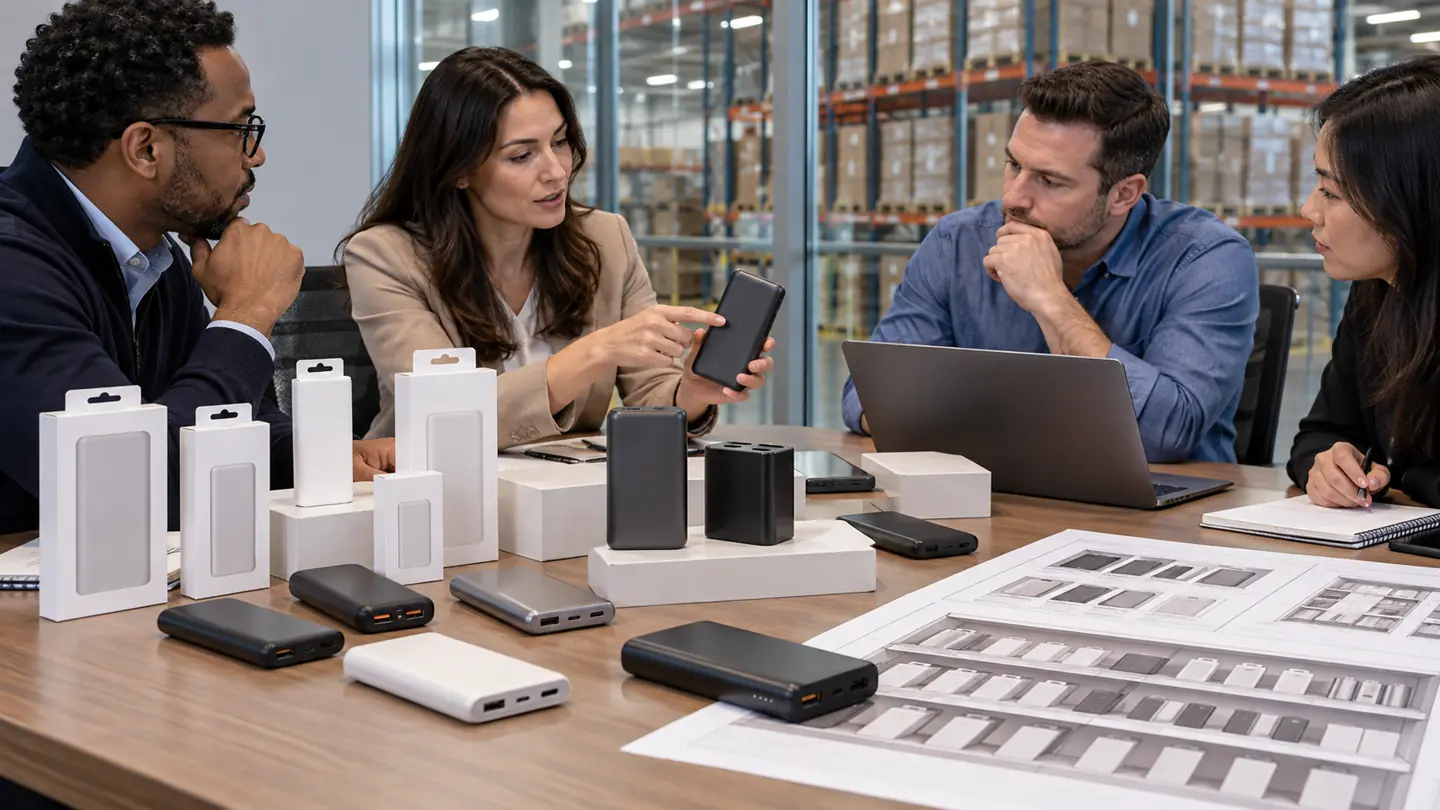
Start with the channel job, not a long feature list. Define the target retailer or distributor, sell-through price band, device mix, pack size, service route and launch date. Then issue a controlled RFQ that names the same capacity, Wh value, wired output, cable architecture, wireless function, colour, logo process and packaging configuration for every supplier.
| Route to market | Procurement implication |
|---|---|
| Mass retail | Value clarity, barcode discipline, shelf-ready packaging and replenishment consistency. |
| Consumer electronics | Port detail, wattage, compatibility and demonstrable feature separation. |
| Marketplaces | Variation control, image/claim consistency, review monitoring and rapid listing correction. |
| Travel and convenience | Compact size, visible Wh marking, simple cable architecture and quick replenishment. |
| Corporate and promotional | Logo durability, colour approval, packaging proofs and batch traceability. |
A compact 5,000 mAh unit is easy to explain for emergency top-ups and travel. A 10,000 mAh platform is the everyday anchor. A 20,000 mAh platform serves longer journeys and higher-energy use cases, subject to weight, port and transport decisions. ZEROSET catalog references include F91 at 5,000 mAh / 19.35 Wh, F97 at 10,000 mAh / 38.5 Wh, and B102 at 20,000 mAh / 77 Wh. These are platform references, not a promise that every configuration carries the same output, certification or included accessories.
Choose one hero difference per SKU: compactness, built-in cable, magnetic convenience, higher wired power or display clarity. When two products share the same capacity and nearly the same promise, buyers inherit unnecessary forecasting, content and returns complexity.
The importer should maintain a claim matrix linking every front-of-pack, PDP and sales-deck statement to an approved specification or test. Capacity, Wh, USB-C output, charging time, cable type, magnetic compatibility and simultaneous-output behavior require separate evidence. Final route requirements must be checked by the importer, laboratory and logistics partners for the actual SKU and destination.
For mature platforms, the working MOQ is normally 1,000 units per model; deep ODM changes normally begin at 2,000 units per model; a new private-mold design normally begins at 3,000 units per design. Standard colours normally begin at 500 units per colour and custom colours at 1,000 units per colour. Typical samples take 7–10 days and mass production is around 30 days after approvals. Quotations are normally valid for two weeks. These are planning rules; the written quotation controls.
A good RFQ identifies the channel, target launch window, quantity by colour, destination, Incoterm, sample count, packaging languages, barcode owner, logo files, target power architecture and compliance owner.
Use dated retrieval notes. Retail pages are shelf observations, not total-market measures, and availability changes by location.
Capacity and Wh, wired input/output, cable architecture, wireless behavior, size, weight, included accessories, warranty route and evidence package.
Avoid a blanket promise. State the exact Wh value and let the traveller verify current airline and route rules.
Only when differences are unambiguous. Variation families can amplify review and content errors.
Plan enough for buyer review, packaging capture, engineering checks and a retained golden sample.
At architecture selection, before artwork, after the final BOM is frozen and again before shipment.
Send the channel, capacity, target power, quantity, colours, packaging and launch date.