For a UK importer, the hard problem is not finding another power bank. It is controlling a crowded range across high-street, click-and-collect and marketplace listings without allowing capacity, wattage, cable and magnetic claims to drift between SKUs. This buyer guide combines dated official indicators with a live retail-shelf audit and a practical acceptance plan. It does not estimate UK power-bank sales.
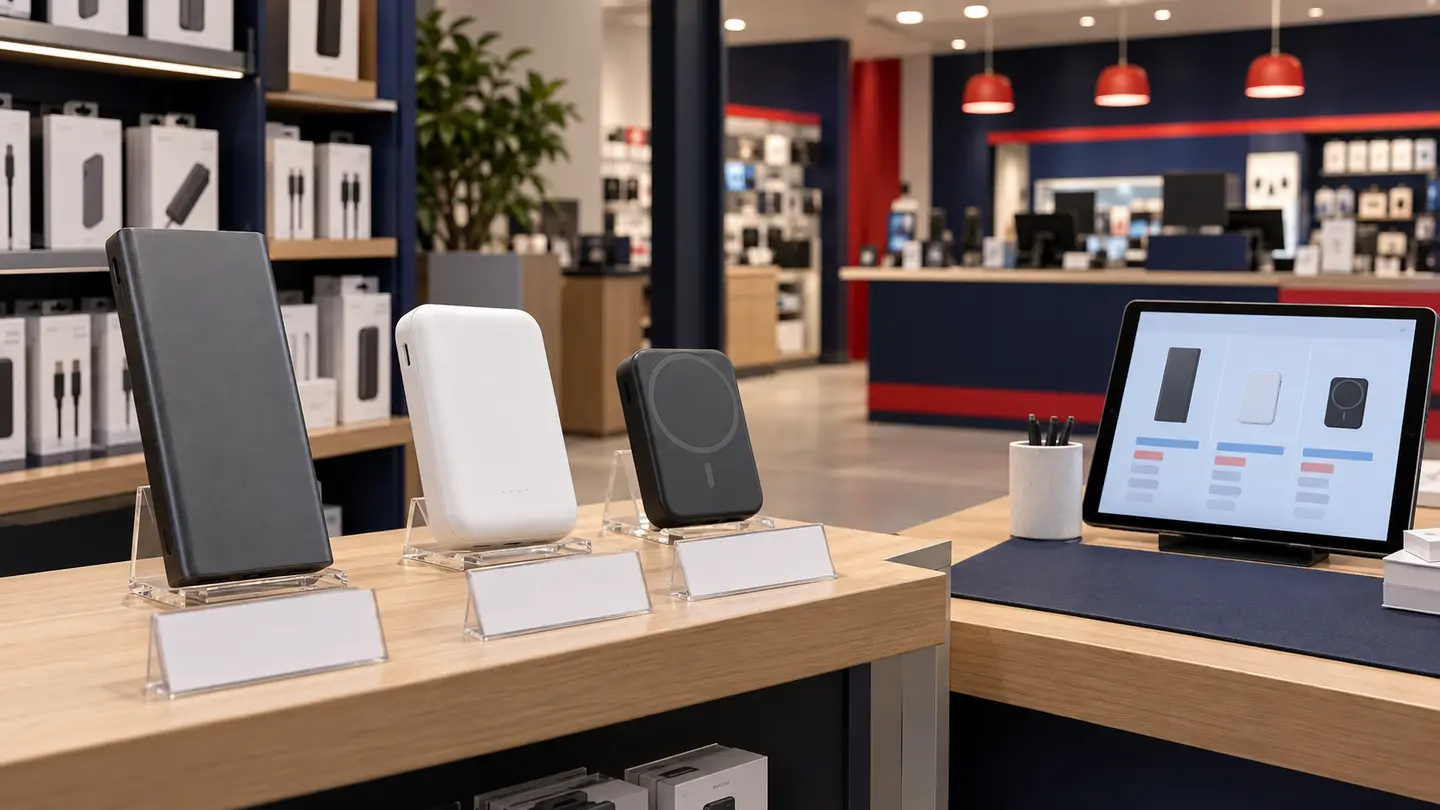
Do not interpret a search result, online product listing or promotional price as in-store stock, sales volume or wholesale cost. For any UK retailer benchmark, record a directly accessible product URL, model number, mAh and Wh, per-port PD output, GBP price, seller, date and stock before adding the figure to a sourcing comparison. This review does not insert a retail price without a sufficiently verified UK listing.
The UK is outside the EU customs union: verify commodity classification, origin, customs duty and import VAT via UK Trade Tariff, and check relevant UK battery rules and applicable electrical/product-safety obligations for the actual destination and SKU. EU CE/Batteries Regulation claims alone should not be assumed to satisfy every GB requirement, and Northern Ireland may need separate treatment. UN38.3 transport testing is not a blanket UK product approval. For ZEROSET range selection, compare current platforms, OEM/ODM options and buyer evidence guides.
The latest available figures below describe the environment in which portable chargers are listed and purchased. They are not power-bank unit sales.
| Indicator | Value | Year/date | Buyer interpretation |
|---|---|---|---|
| Population | 69,487,000 | 2025 | Scale indicator only. |
| GDP per capita | US$57,602 | 2025 | Macro purchasing-power context; not an accessory budget. |
| Individuals using the internet | 95.5% | 2024 | Digital listings can reach most consumers. |
| Urban population | 83.3% | 2025 | Supports city-store sampling, not a national demand multiplier. |
| Mobile subscriptions | 121.6 per 100 people | 2024 | Multiple subscriptions are possible; this is not a handset count. |
| Air passengers carried | 118.9 million | 2023 | Travel is relevant, but it does not prove airline acceptance of any SKU. |
| Online share of Great Britain retail sales | 28.8% | August 2026 | ONS reported an increase from 28.4% in July. |
| Online sales value change | +2.5% month-on-month; +8.9% year-on-year | August 2026 | Shows online retail momentum across all retailing, not power banks alone. |
| Currys category results | 97 results | 6 Oct 2026 | A live category count, sensitive to stock and filters. |
| Argos category results | 85 products | 6 Oct 2026 | A second dated shelf count, not market share. |
Sources: World Bank population, GDP per capita, internet use, urban share, mobile subscriptions, air passengers and the ONS August 2026 retail release.
The Currys category showed 97 results: 62 marked delivery available and 34 collect-from-store. Its price filters contained 57 items up to £39.99, 18 at £40–£59.99, 19 at £60–£99.99 and 3 at £100–£499. Visible brand filters included Belkin 22, Anker 11, Our Pure Planet 11, Fresh ’n Rebel 10, and Energizer, Hama and Sandberg at 7 each. These counts overlap neither sell-through nor stock by postcode.
The Argos category displayed 85 products on the same check date. Visible listings included 5,000mAh magnetic, 10,000mAh wired and magnetic, 20,000mAh built-in-cable, 26,000mAh and output labels from 15W through 165W. This is evidence of a wide claim ladder. It is not proof that the highest wattage or capacity is the best opening SKU.
| Observed shelf lane | Examples visible | Buyer risk | Acceptance evidence |
|---|---|---|---|
| Slim magnetic | 5K and 10K titles | Universal-fit language; case and camera interference | Phone/case matrix, alignment photos, wired fallback and heat observations |
| Mainstream wired | 10K at 15W, 20W, 22.5W, 30W and 45W | One wattage copied to every port | Port-specific protocol and measured test sheet |
| Large cable-equipped | 20K at 22.5W, 30W, 45W, 65W and 87W | Capacity, cable and power revisions mixed in one listing | Distinct EAN/SKU, carton code, Wh label and cable-cycle test |
| High-output niche | 20K listing at 100W and 165W | Laptop-use assumptions and price comparison against phone-only SKUs | Named load devices, sustained-output and thermal test conditions |
Use B97 10K as the commuter/cable sample: the current catalog states 10,000mAh, 38.5Wh, 175g, USB-C port/cable output up to 35W and USB-A up to 22.5W. Pair it only if needed with F99 20K: 20,000mAh, 77Wh, 136 × 69 × 32.5mm and up to 22.5W on the specified USB-C path. The two SKUs serve different jobs; the larger battery is not the faster catalog model.
For both samples, freeze the cell/PCB/cable revision, photograph the rating label, measure every advertised output path, cycle the built-in or retractable cable, and check that the online title, comparison table, carton and support script use the same figures. Link the deeper compliance handoff to the existing EU and UK launch-file guide instead of repeating it here.
Great Britain and Northern Ireland should not share an unchecked market file. Current UK government guidance says businesses may use UKCA or CE marking for listed GB electrical, EMC and RoHS product regimes under continued recognition, while importers must confirm the applicable rules, technical documentation, identity details and English instructions. The official GB marking guide and waste-battery producer guidance are starting points, not certification of a ZEROSET model.
UK distance-selling guidance says customers can cancel an online order up to 14 days after delivery and then have another 14 days to return it. Treat cancellation, compatibility dissatisfaction and confirmed defects as different outcomes. A high return count without the units sold, channel, revision and reason codes cannot guide the next purchase order.
No. Official population, connectivity and online-retail indicators describe market context. Retailer category counts are dated shelf observations. Neither is a sell-through or market-share dataset.
Public shelf prices, retailer listings and search visibility do not by themselves establish national UK unit sales. They show a sampled assortment, not audited sell-through. Separate observed price tiers from assumed market demand, and validate commercial opportunity against target audience, wholesale costs, warranty exposure and distribution channels.
Name the exact USB-C port or built-in cable, protocol, voltage/current path, cable, phone or load, starting battery state and measured result. A maximum printed in a catalog is not a promise that every device sustains it.
Approve wattage against the exact USB-C PD/PPS profiles, cable rating, single-port and simultaneous-use output and sustained thermal testing. The maximum 35W or 45W label does not guarantee identical charging performance on every phone. Align online listing, user instructions and retail carton to the tested SKU.
Show units sold by SKU and channel, batch or revision, days since sale, phone and cable used, symptom, photos and repeat-test result. Keep transit damage, buyer remorse and verified product faults separate.
Record the model and PCB revision, batch number, fault description, mobile device, cable, charging conditions and photographs. Distinguish failed charging negotiation from actual cell faults, connector damage or misuse. The first report should support containment and investigation, not simply classify all complaints as defective batteries.
Only after route-specific review. Keep the core technical evidence aligned, but verify the applicable economic operator, marking, instructions, waste-battery duties and marketplace fields separately for GB and Northern Ireland.
Great Britain and Northern Ireland may involve different applicable product, marking and economic-operator requirements. A single technical product may be feasible, but the importer must verify the requirements in force for each market and ensure listing claims, instructions and labels remain accurate. Avoid assuming all UK-wide obligations are identical.
After B97 sell-through and support data show a distinct demand for longer runtime or a retractable cable. Use a separate listing and returns code so the 77Wh F99 is never confused with the 38.5Wh B97.
Add a 20,000mAh F99-class option only when shoppers have a clear need beyond a compact 10K offering. Confirm which F99 capacity and revision are being quoted; similar model-family names can cover materially different battery packs. Assess weight, rated output energy, retail shelf price and product evidence before expanding.
Compare China power bank OEM/ODM suppliers against an identical approved specification, not catalog photographs. Request cell/PACK traceability, USB-C PD output reports, production controls, model-specific regulatory documentation, accepted golden samples and an EXW quotation that lists inclusions. A low quoted price may exclude packaging or testing scope.
UN 38.3 concerns lithium battery transport testing and is distinct from marketing claims such as universal airline approval. Ask for the documentation applicable to the finished battery configuration and consult the actual carrier and route requirements. Capacity stated in Wh, not just mAh, helps establish the shipment context.
A UK buyer should specify capacity, Wh, charging wattage and profiles, USB-C ports or integrated cables, finish, logo, packaging, sales channel, forecast quantity and delivery basis. Request a sample acceptance plan and identify which compliance evidence is available, missing or dependent on final design approval.
Send the target channels, price architecture, phone/laptop use cases and first two SKU candidates to ZEROSET on WhatsApp first. For a controlled specification and sourcing request, submit the RFQ form second.