Buyer brief. Trinidad and Tobago supports electronics, telecom, mass retail, travel and regional distribution. Buyers need clear master data and an assortment that remains understandable across both islands. This guide does not estimate national sales.
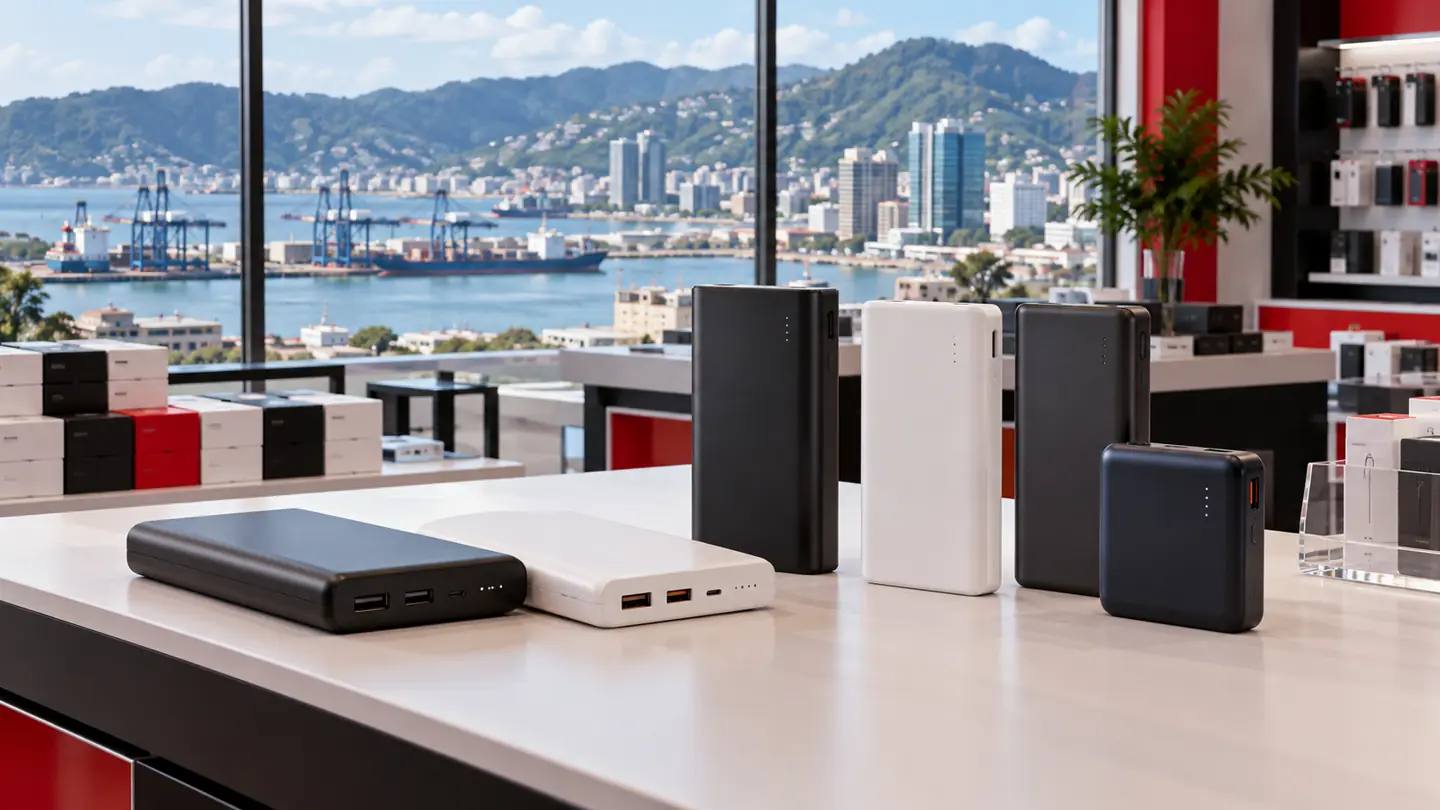
AI-generated sourcing illustration; not a customer project photograph.
Ten local decisions
Define importer, tax, customs and warranty ownership before quotation comparison.
Plan Trinidad and Tobago replenishment and service as linked but distinct flows.
Use capacity, Wh, USB-C power and cable architecture consistently in all content.
Account for humidity, heat and repeated port or ferry handling in packaging.
Date observations from Courts, PriceSmart, telecom and specialist retailers.
Avoid broad compatibility and airline claims without exact test scope.
Separate one-port maximum power from multi-port shared behavior.
Keep the golden sample, approved artwork and BOM at the same revision.
Tie UN 38.3 and logistics files to the final cell and finished SKU.
Classify returns so expectation issues do not hide real quality failures.
Range and evidence
F91 (5,000 mAh / 19.35 Wh), F97 (10,000 mAh / 38.5 Wh) and B102 (20,000 mAh / 77 Wh) cover compact, daily and high-capacity roles. Power, accessories and evidence depend on the approved SKU.
Approval plan
Specification, BOM, artwork and label.
Golden sample and claims.
Pilot: charge, temperature, cable, connectors, drop and carton.
Aligned content and service.
Inspection, lots and logistics hand-off.
Commercial path
Planning: 1,000 units/model for mature platforms; 2,000 for deep ODM; 3,000 per design for a new private mold. Standard colours: 500/colour; custom: 1,000/colour. Samples: 7–10 days; production: around 30 days after approvals; offer: normally two weeks. The written quotation controls.