A retail buyer can compare a commuter magnetic line with a travel cable line, but each listing needs a separate claim sheet and returns code. This guide turns public context into questions for an importer, distributor or retailer; none of the country indicators below measures power-bank sales.
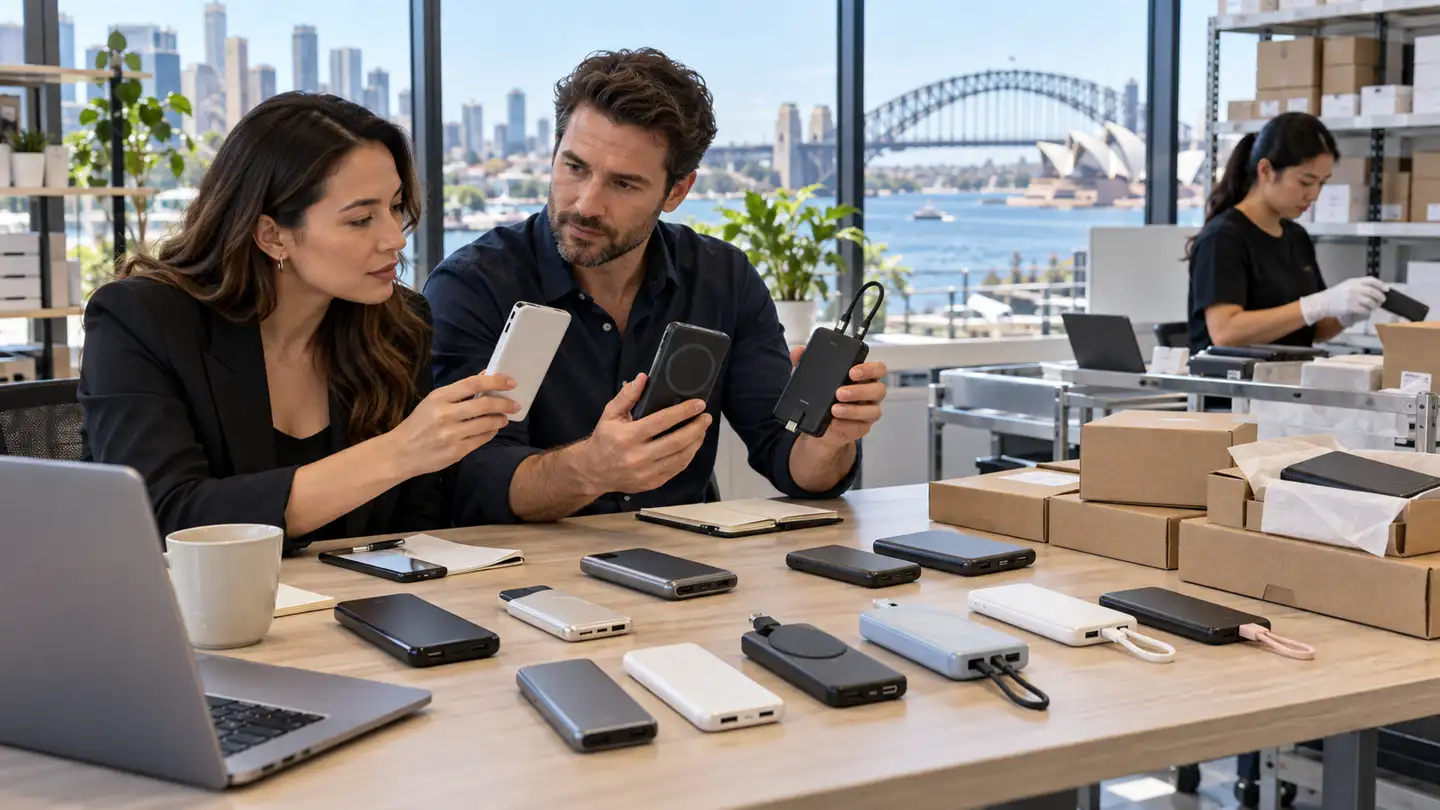
Kmart lists 10K/20W SKU P_43553778 for A$29 and a 37Wh lithium polymer battery. Bonelk MagTec 10K is A$89 and online-only. These are retail asking prices, not sales or wholesale quotes. Australian Border Force requires correct import classification; Tariff Advice is available for specific goods. Verify HS, GST, electrical compliance, battery Wh and UN38.3. Potential buyers are private-label accessory brands and retail-chain suppliers; no partnership claimed. ZEROSET ODM.
Australian buyer approval should distinguish advertised retail prices from landed OEM prices and store stock. Record each SKU’s retailer URL, AUD price, date, watt-hours, per-output charging profile, casing/cable revision and warranty. The ACCC lithium-ion battery safety report explains that there is no single universal mandatory Australian safety standard covering all lithium-ion batteries and battery products: obligations depend on the product. Verify imports and duties with the Australian Border Force, and applicable national or state-based battery stewardship requirements; do not claim that UN 38.3 alone demonstrates Australian product approval. Compare ZEROSET platforms, custom development and buyer resources.
The latest available observations below come from the World Bank API and use different reporting years. Population sets scale, internet use informs digital listing reach, electricity access describes a household service, and urban share suggests where a first store audit may be practical. None gives unit demand, annual sales, capacity preference or an import forecast.
| Indicator | Latest value | Year | Source |
|---|---|---|---|
| Population | 27,614,411 | 2025 | World Bank indicator |
| Individuals using the internet | 96.1 | 2024 | World Bank indicator |
| Population with electricity access | 100.0 | 2024 | World Bank indicator |
| Urban population share | 87.7 | 2025 | World Bank indicator |
Internet use is 96.1% (2024); a marketplace listing can reach some buyers, but offline shelf evidence remains essential. Urban share is 87.7% (2025), which should guide sampling locations rather than be multiplied into a sales forecast. Electricity access of 100.0% (2024) does not tell us outage frequency, charging habits or willingness to pay.
Australia's JB Hi-Fi currently lists both a slim magnetic 10K format and a 20K built-in dual-cable format. This is a shelf observation, not a sales ranking. View the cited shelf or context source. Capture the date, retailer, item name, nominal capacity, connector, stated output, displayed price and in-stock status. Compare like for like only after checking whether each figure refers to the input, one wired output, wireless output or combined output.
Use F91 5K (19.35Wh, 117g, 102 × 68 × 9.3mm) for a slim-phone trial and F99 20K (77Wh) for a larger cable-led lane. Keep listings, imagery, and carton identifiers separate; test F91 alignment through the actual case and F99 retraction over repeated cycles.
For marketplaces and stores, record the tested handset, cable, port, battery state, and measured output for every advertised condition. A maximum USB-C rating does not imply that every phone sustains it. Link refunds to model, revision, channel, and claim wording.
Ask for a golden sample tied to the model and revision on the carton. Test input and output with a named handset, cable and meter; photograph connector fit and the printed battery-energy label. Define pass/fail for cable retention, ports, housing and packaging before the purchase order. For the first sell-through review, keep a weekly line for opening units, receipts, sales, stockouts, transit damage and confirmed customer faults. Show both counts and percentages; a percentage without a sold-unit denominator is misleading in a small market.
Give each format its own capacity/Wh, dimensions, wired or wireless output path, case-fit conditions, cable description and revision code. Do not transfer a 20K cable claim to the 5K magnetic SKU.
Certifications and technical test reports apply to particular battery configurations and identified product versions, not automatically to every product that shares a visual shell or commercial series name. Ask for the exact cell/PACK, PCB revision, model designation and report scope. If a supplier proposes a new cable, battery, charging board or enclosure, require an engineering assessment of what previous evidence remains valid. Distinguish transport testing from electrical safety, marketplace requirements and importer responsibilities. Australian wholesale buyers should keep online product listings and shop-channel packaging consistent, compare warranty records between channels, and check applicable Australian product and battery obligations with their local importer or adviser. For this Australia OEM/ODM power bank project, record the chosen model, reference sample and evidence still needing confirmation rather than relying on generic certification or charging claims.
Request the model and revision discussed above as a physical sample. Include the connector, capacity/Wh label, port-specific output, packaging and one test handset in the acceptance sheet; do not substitute a similarly named variant.
A sample window of roughly 7–10 days may be a planning reference for a mature OEM platform after artwork and specifications are settled, but it is not a guaranteed dispatch promise. A private mold, different power architecture, customized carton or new compliance test can extend the schedule. The buyer and factory should agree milestones for RFQ approval, engineering review, sample build, test feedback, golden sample acceptance and production release before advertising a launch date. Australian wholesale buyers should keep online product listings and shop-channel packaging consistent, compare warranty records between channels, and check applicable Australian product and battery obligations with their local importer or adviser. For this Australia OEM/ODM power bank project, record the chosen model, reference sample and evidence still needing confirmation rather than relying on generic certification or charging claims.
State the exact port or cable, test voltage/current path, phone model, battery state and cable used. A catalog maximum is conditional, and sustained phone charging can change as the battery fills or warms.
Select capacity and output based on actual customers. A 10,000mAh SKU can offer a smaller and less costly daily-carry format; a 20,000mAh SKU provides more nominal energy but increases size, freight weight and often shelf price. Compare Wh, usable USB output, cable convenience, charging profiles, after-sales exposure and retailer margin, not merely the largest printed mAh number. A new private-label range may be more credible with one validated core SKU than too many similar variants. Australian wholesale buyers should keep online product listings and shop-channel packaging consistent, compare warranty records between channels, and check applicable Australian product and battery obligations with their local importer or adviser. For this Australia OEM/ODM power bank project, record the chosen model, reference sample and evidence still needing confirmation rather than relying on generic certification or charging claims.
Log invoice date, store or island, model, revision or batch, sale count for the period, fault symptom, photos and the result of a repeat test. Separate shipping damage from a verified electrical or mechanical fault.
UN 38.3 concerns defined lithium-battery transport tests and is not a blanket approval for commercial sale in any country. Review the exact final battery configuration, its test-summary applicability, shipping classification, carrier conditions and the market-specific legal obligations of the importer. A CE, FCC or transport test mark alone is not enough to establish all required approvals. Keep report identifiers, battery energy in Wh and current documentation aligned with the actual SKU. Australian wholesale buyers should keep online product listings and shop-channel packaging consistent, compare warranty records between channels, and check applicable Australian product and battery obligations with their local importer or adviser. For this Australia OEM/ODM power bank project, record the chosen model, reference sample and evidence still needing confirmation rather than relying on generic certification or charging claims.
Compare alignment and case-fit complaints for F91 separately from F99 cable-retraction or port faults, each against sold units per channel and revision.
An unconditional ‘airline approved’ claim is too broad. Rules may depend on battery energy in Wh, spare-battery treatment, passenger cabin or cargo context, airline policies, route and local authority instructions. The factory can provide a defensible nominal battery energy statement and relevant product documents; it cannot guarantee acceptance on every flight. Avoid converting general passenger guidance into an assertion that a commercial air-cargo shipment is authorized. Australian wholesale buyers should keep online product listings and shop-channel packaging consistent, compare warranty records between channels, and check applicable Australian product and battery obligations with their local importer or adviser. For this Australia OEM/ODM power bank project, record the chosen model, reference sample and evidence still needing confirmation rather than relying on generic certification or charging claims.
Before starting mass production, freeze the approved cell/PACK and PCB bill of materials, USB-C PD/PPS profiles, built-in cable or magnetic components, enclosure finish, packaging, barcode and warnings. Verify output limits, thermal performance, mechanical durability, rated energy and any market-specific documentation against the golden sample. Engineering changes require risk review and written approval, especially where component substitutions can change product claims or test scope. Australian wholesale buyers should keep online product listings and shop-channel packaging consistent, compare warranty records between channels, and check applicable Australian product and battery obligations with their local importer or adviser.
Online retail prices reflect promotions, seller commission, tax, import duty, local logistics and warranty risk, not simply the EXW factory price plus margin. Use dated retailer comparisons and clearly identify the model capacity, wattage, connectors and pack contents. Marketplace listings do not prove sales volume or factory origin. Build a landed-cost worksheet with the intended Incoterm, carton specifications, freight route and realistic returns allowance before choosing price tiers. Australian wholesale buyers should keep online product listings and shop-channel packaging consistent, compare warranty records between channels, and check applicable Australian product and battery obligations with their local importer or adviser.
Send the destination country, target consumer, capacity and Wh, desired 22.5W/35W/45W USB-C charging capability, connector and cable format, branding artwork, color split, retail package, forecast volume and expected launch date. Ask the supplier for a written, model-specific EXW Dongguan offer defining inclusions, tooling and samples, applicable test evidence, acceptance criteria and production assumptions. Avoid generic catalog quotations that fail to identify the approved hardware revision. Australian wholesale buyers should keep online product listings and shop-channel packaging consistent, compare warranty records between channels, and check applicable Australian product and battery obligations with their local importer or adviser.
Send your channel, target handset and case mix, preferred connector, trial quantity and test checklist to ZEROSET on WhatsApp first. For a structured specification and sourcing request, use the RFQ form second.